In Praise of Idealism
"At the dawn of Islam, when the realism,
rationalism, pragmatism of Islam were hatching in proximity of our land,
the voice of Mansour Hallaj echoed in the market place of Baghdad
running out (more likely nude) from bath and screaming “I’m God, I’m
God.” Centuries later, when Islam saturated Iranian life and its reality
became almost undeniable, another Sufi master wrote, “Let’s cut through
the sky and design a new world there.” I do not know if any of these
two Sufi masters were worried about reality, rationality, and
pragmatism. "
To read the rest, click here.
Monday, December 01, 2014


Friday, November 18, 2011
Dog Sweat
Directed by Hussein Keshavarz and MaryamAzadi
Screen play by Maryam Azadi
In the opening scene, a few young boys are having
a casual party, drinking and debating the quality of Johnny Walker Red vs.
Black or Gold label while what they have access to is only a poor local vodka
commonly referred to as dog sweat.
The boys’ party breaks up when one of them is called by his uncle to rush to the hospital to attend his mother
who had been hit by a car on a bridge. He leaves the three other to weave the
tapestry of Iranian youth and their problem for us.
The next scene is of their female
counterparts. The girls, who will later each become connected to these boys,
are preparing themselves for a party, putting make up on each other, having
short chats about the boys, dropping remarks and even flirting with each other.
And then we met all the characters of the film in a loud mixed party just for a
second or so which ends quickly with a sombre, slower life.
The complex of the youths’ relationships
with each other, with their preceding generation, with society’s normal and abnormal
is portrayed and narrated freely by the youths themselves. Simple friendship,
the cornerstone of Iranian society and culture, developed into incongruous
phenomena. Sexuality emerged even more confusing without proper rules of
conducts. Giving in to the expectations or following one’s will and ideas leads
to indecision. Finally, fitting into society
and letting one’s identity be shaped by it or changing it to one’s desires, or
simply letting go of both and submitting to whatever goes glues all these
confusions together in a thematic series short episodes.
The setting is the streets or parks of Tehran,
dotted with only few scenes inside which we meet a pair of the opposite sex.
Though the film gives us a chance to visit Tehran with all its noise and contradictions,
it seems that the outdoor life has also been selected quite purposefully for
this film, where the private and inner side of youth are closed to us as well
as to themselves.
*******
Not long into the film, I felt that I had
an urge to scream, “Say something for God’s sake!” when immediately the facial
expression of an actress shuts me up, saying, “What is there to say. Don’t you
see?”
No, I don’t see if there is no talk, no
laughter, no crying, no discussions, no debates, no complaints, no questions, no
answers, not a single complex sentence. But why?
“We are in strange land my dears, where
language has gone through a massive transformation. Language as the medium for communication has
lost its function where communication has lost its place in the society and
culture, where the efforts are made to hide rather than reveal, where one must
divert rather than to direct, where one has to misguide rather than to guide;
then words are better forgotten if one has to lie,” I’m whispering to myself.
Lips do not kiss, hands do not touch, gazes
are afraid to connect. It is not restraint but hiding. There is no need for
censorship since there is not even any desire for of any sort expression. There
is still an outcry for an “empty nest,” an empty room, a dangling key to an
empty apartment. It seems that finding “that key” is the ultimate goal, though
I’m not so sure that there is anything but darkness behind the closed door. Even
passion is absent …
But
little by little, I learn to hear them. I learn their
language. It is very simple, their facial expressions, sweet faces with bitter
and sad expressions, tell us of boredom, aimlessness, hopelessness, very gently
and good-naturedly. But beneath those
bitter expressions on those faces, those cold faces, those deadly silences, one
can see the residue of some drive, of some hope and some faint and colorless
shadow of something that might once have been a dream or fantasy.
They narrate their own story, as if the
film were a documentary and had been made spontaneously, with actors and
actresses, without script, on stage thriving to tell their stories. It seems
they have something to say only if they find someone to listen, if they feel
safe, if they find privacy, if they know how.
The story is also about a lonely generation
which has to live an unexamined life, a life without serious challenge, without
tough critics, without interaction and even without a given, the clash between
two generations. A tale of living in two worlds with no connection in between,
the worlds of young and old, public and private, openness and dead tradition.
The story of a generation which is even deprived of the unity that should exist
naturally within the family. It seems that this dual existence has crept under
the skin of life permanently and has given each a double self.
Sexuality is confusing, as is expected,
though there are not only heterosexual relations but gay and lesbian ones. It
seems it is the main preoccupation of our young generation, torn between tradition,
the mainstream, avant-garde fads or even sometimes biological needs. Gay
couples that do not even dare to admit it to themselves, naively thinking that
they can have it both ways, a heterosexual marriage and a supplement of homosexual
relationships in the guise of a regular one. Confused, wondering why it fails...
Tradition and modernism clash with each
other quite often and the youngsters, as well as parents and older generation, learned
to get around it or pass by it without being affected by it or even without
trying to get their point across. No, we do not hear the cliché of my
generation, “You don’t understand me.” They simply assume the barrier is
impassable. They are resigned to it.
And yes, resignation! It comes in all forms
and shapes. A gay couple finds no other way but to give in to their parents’
demand for a conventional marriage. To make her mother happy, a girl consents
to marry a gay man and give up her dream to become a pop singer, only to find
out shortly after that she had made a mistake;
her mother’s real happiness lies in the tomb of a martyred imam in
Najaf.
Disillusions, failures, and disappointments
all come one by one as one may expect. Kathy, our lost soul, separates from a
lover, her cousin’s husband, and does not know what to do with the proposal of
an admirer who appeals as a last resort to attract her “an apartment in Dubai
and a car there waiting to make her happy.” This is tempting enough to drag her
out bed to move out of the house let herself be picked up by the third or
fourth car that stops by, “Hey! Let’s have a little fun!” Her smirk betrays
her. She does not believe in having fun either, but she sits in the back seat
impassively. In a car behind her, the
boy is watching her wondering if she didn’t care for the “apartment in Dubai
and a car waiting” or she didn’t believe it.
And, yes, parents, the generation that in
their youth witnessed all their values and learning turned into nothingness over
night, are not even prepared to face the kind of problem their children may
face, leave alone know how to deal with it:
A mother notices his son is gay and
suffering in his new role as a married man and she cries!!
Another finds a condom in her daughters
room, slaps her on the face and locks her in.
A religious mother does not know what to do
with her daughter who sings underground and pushes her to marry the first
suitor who comes along.
And where are the fathers? All absent. One
is making money somewhere. The rest are dead, or martyred.
Even death seems incapable of bridging the
gaps between these two worlds. Upon the mother’s death in the hospital, our
young character, torn between the mother’s siblings, pushes him for revenge and
the guilty driver and his wife beg his forgiveness. He turns away to free himself
from the burden of executing this justice. “What is my right? Who has any
rights in this country?” In pain and agony, in need of love and support, he is
offered only the opportunity to revenge. He submits to it, thought, avenging himself.
He gets into arguments with three Basijis
in an isolated place in the middle of a dark night and gets killed.
Yes the movie moves quickly from one
episode to another just to hastily depict the scenes of loneliness, despair,
resignation, and hopelessness. It is indeed gloomy and dark, the life of
generation of victims whose name we never learn.
But all through they all remain
good-natured kids who simply want to live, just simple living, the only thing
they do not have a right to.
Mariam Azadi and Hussein Keshavarz did
marvels in this film. They both took us into the heart of young Iranian
society. I assume their personality,
their passion for their profession, and their dedication has contributed to the
actors and actresses in this film offering their best. Not only have they
provided a safe and private place for them to narrate their story, but they
carried it safe and sound to us in this part of the world to listen to their
outcry. Indeed, their story came right across and sat in our heart. So many thanks to them both for the wonderful
job they did.
Wednesday, October 26, 2011
The Iranian Third
Who is the third who walks always beside
you?
When I count, there are only you and I together
But when I look ahead up the white road
There is always another one walking beside you
Gliding wrapt in a brown mantle, hooded
I do not know whether a man or a woman
But who is that on the other side of you?
When I count, there are only you and I together
But when I look ahead up the white road
There is always another one walking beside you
Gliding wrapt in a brown mantle, hooded
I do not know whether a man or a woman
But who is that on the other side of you?
T. S. Eliot
Really, who is that third
who is always walking beside us Iranians in the Diaspora? Who is that “Iranian”
who appears in our minglings, in our workplaces, in our parties, or in our
daily meetings here and there who is not like us but has a much stronger
presence than us, that invisible Iranian who is like none of us but is like all
of us? Where has it come from and who created it?
The American Embassy inTehran was taken over by Iranian students during my first year of teaching in
college. Overhearing my conversations
with faculty members, my students learned that I’m not American and my home is
somewhere else; though, I had no idea why my accent had not clued them in! In any case,
in one class, students asked me where I’m from. “Guess,” I said. After a wide
range of guesses, ranging from South Africa to Sweden, we got closer to
“somewhere in Middle East.” I asked them where in the Middle East. Surprisingly
one of them said “Somewhere like Africa!” I finally told them I’m from Iran.
“Wow! But you don’t look like one!” “One of whom?” I asked. “Those in the
street in front of the Embassy.” I’m not
sure if I would have felt better or worse had he said, “Oh, we thought so!” But
the fact that students who thought that Africa is somewhere in the Middle East
already had formed a fixed image of us within a few days certainly made quite a
difference in my life, I learned that there is another “me” walking besides me
that I must make sure does not overshadow me.

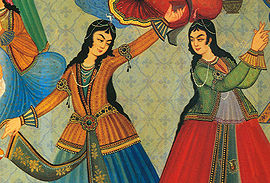 And then arrived political about
us stories with all the characters either confirming the images of the American
Embassy occupation or testifying to the truth of Betty Mahmoodi’s experiences:
all men unpredictable, brutal, and irrational and the women, desperate,
helpless, betrayed, and beaten up in their private lives, if not tortured,
raped, and, in many cases, executed in prison. These stories left nothing more
for the characters to do but to defy and turn “defiance” not only into the main
theme of our contemporary literature and art, but as an epithet for us, a caricature
of being Iranian.
And then arrived political about
us stories with all the characters either confirming the images of the American
Embassy occupation or testifying to the truth of Betty Mahmoodi’s experiences:
all men unpredictable, brutal, and irrational and the women, desperate,
helpless, betrayed, and beaten up in their private lives, if not tortured,
raped, and, in many cases, executed in prison. These stories left nothing more
for the characters to do but to defy and turn “defiance” not only into the main
theme of our contemporary literature and art, but as an epithet for us, a caricature
of being Iranian. 
In reality, however, we
write a book and create a work of art to tell the world our stories, how we
experience life and how we deal with it. Through our art, we try to record
history—our identity—to leave a trace for the next generation, for them to know
how far we have come to get here. Our artifacts testify to the life we have
lived, something to speak for us and tell our tales when we are gone.
Undoubtedly life, and our experience of it, is much greater than a few symbols
and traits “describing” us over last few decades. Why should this temporary passing
phase take precedent over our history? And why should we create a false image,
base on a slippery ground of a political page of history, instead of presenting
our reality?
This is by no means to deny
the emergence of a new culture during the last three decades, the regime’s
brutality, the security forces’ violence and lawlessness, or even disorders
among civilians. Of course there is no doubt about recurring rape, torture, murder
and executions in prison, as is the nature of a dictatorial regime. An alarming
amount of domestic violence can also be seen. However, literature and art are
about the wider spectrum of life and not only a display of our anger and frustration
towards certain period of history. Neither are the territories of our nation
limited to the span between Evin Prison and Behesht-e Zahra Cemetery.
Even though the roots of
many of the country’s current problems are the malice of the dictatorial regime
which has created a suffocating climate for all, many of our concerns could be
discussed meaningfully from different perspective. Gay and lesbian citizens are
not all executed, though they still face huge amount of obstacle in their way
to happiness and fulfillment in Iran’s traditional society. Women are not all
facing the threat of stoning, but the local custom and the family relations and
lack of communication between man and woman which allow a man to testify
against his wife to be stoned in more damaging and of greater concern. If the
laws of censorship stop authors and journalists from expressing their thoughts,
unwritten habits of talking in metaphors, general terms, obscure references to
vague ideas, and reference to unidentified entities are more detrimental still.
If artists, artisans, thinkers, intellectuals, and writers do not step up to
change these habits, removing censorship will be of little help.
The community of elites in the
Diaspora should be more held to account in spreading these stereotypical images
than any anyone else. Could we not pay more attention to human needs in a
humane society? Could we not promote and emphasize the positive characteristics
of our culture that has older tradition than those imposed laws of sharia which
have emerged during the last few decades? Could we not contemplate a bit over
the virtues we share with the community of nations and build a bridge to them
as a passage to a global village rather than focusing on petty eccentricities
that divide us and lock us forever in our local tribes?
While many elements may
have contributed to forging this kind of model, each of us bears a still greater
responsibility. It is up to us to keep the balance between the images we
present to our host countries about ourselves, our nation, and our character
traits. It is so unfortunate that society has become so sluggish that clichés
have an easier time to register themselves. It is so unfortunate that we, as
refugees, political or otherwise, sometimes have to exaggerate our grievances
in order to be heard. It is even more unfortunate that we sometimes come into
competition with so many that we have to turn to the most remote and the most
eccentric aspects of our customs and traditions in order to catch some
attention. But there are still so many of us that enjoy a kind of security and
peace to be able to focus on the more meaningful aspects of our existence.

Why don’t we discuss our
problems as they are? Why don’t we present ourselves as we are? The image we
have created not only won’t help us to pursue our happiness in our adopted
country, but will give a false identity to the next generations. Why don’t we
want to take a measure against this falsehood? If we do not do it now, our
children in future will have to pay much higher price to do the remedy.
Saturday, October 01, 2011
The Ayatollah and I
47th
Street was not as crowded as it used to be around this time of year. The
Iranian–Canadian Human Rights Defender and Ashraf Dehghani’s leftists had their
stage set at the entrance to the 2nd Ave. table. The HRD’s
dances and comic performances appeared even more avant-garde against the
Dehghani group’s outdated leftist flyers published in 1975, five years prior to
the Islamic revolution! All I could do was to say hello to my friend Shabnam
Assadolahi and run to “Ayatollah Khamenei” to fix his costume.
A
little further, in the middle of street towards First Avenue, the People’s Mojahedin had already started their act. John Bolton, speaking to the rally,
was projected on a large screen. There was enough room for us to set our stage
and wait for them to finish so we could start ours. Monarchists with pretty umbrellas decorated with Iranian flags and the Lion and the Sun emblem on them were
gathering little by little. Their rally was scheduled in the interval between
Mojahedin and us, the Special Committee to Protest Against Ahmadinejad’s
Presence in the UN.
I
started quickly to fix Ayatollah Khamenei’s outfit. It went quicker and better than
I expected. It turned out to be even more elegant than Khatami’s tailored
robes! But there was a little problem wrapping the turban around his head. The
fabric was slippery and resisted puncturing by safely pins. But it was done.
I was so proud of myself that I could make such an aba and ammameh and I
walked Mohammad, the first volunteer to pose as the Ayatollah, into the cage.
(Not to tire him, few friends each took turns posing as the
Ayatollah!) We were not sure which of his hands were crippled, but Mohammad
correctly used his right hand and placed it right over his chest exactly as the
Ayatollah himself poses. Perfect! All of a sudden, everybody rushed to take
photos of him and with him. Oddly enough no one abused him. There were no
insults, no beatings, no tortures, no interrogations, and no confessions. Only
one gentleman came and posed as if trying to strangle him very gently and
softly. We made sure he got plenty of sunshine and fresh air. We even helped
him dress and undress. And since it was too hot under all those garments, we
gave them cold water every so often. But very soon we noticed that Ayatollah
seemed to be enjoying himself behind the bars and was smiling! Oops!
Artoro, a musician from Spain, who plays flamingo guitar, started the program. One
of our friends, Fawzy, read Majid Tavakkoli’s letter of from prison addressed to Khamenei. Alan Koushan played the santur. Dr. Sedarat talked about the
political prisoners and I mentioned Bahareh Hedayat and Atefeh Nabavi, but
since there were not enough people to read the biography of each women
prisoner, most of them went unmentioned. The program ended with Sadra and Mary,
the masters of ceremony, singing the old fedai song, “Winter is over and tulips are
blooming all over the mountains.”
We
stayed until five and then packed to go for dinner and chat with our friends
Enayat and Marmar who took the trouble to come from California and from Atlanta,
Georgia. (No, she was not from Nicaragua (see previous post), she is pure Persian, from Luristan
no less!) We went to a Turkish restaurant owned and staffed entirely by
Kurds, including a young and handsome waiter serving at our table. Oddly
enough, as much as we insisted that they are Kurds with a Kurdish identity and
should be very proud of their ethnicity, they refused our generous offer. Our
handsome waiter, with a smile, insisted that he is a Turk and Turkey is his
country. Some of our leftist friends jokingly tried to provoke them by
saying they are brain-washed, but that did not work either. I bet later
on they would regret not accepting our offer. I do not think they would receive
such offers anymore. Well, at least, we did our best.
Back
at home checking the television and web site reports, I could not find anything about this action. It seems that the Mojahedin won the trophy of “the only
opposition with organization.” The HRD were criticized for being too much of a
carnival, too festive and celebratory. We were not mentioned at all, as if we
didn’t exist. The monarchists were mentioned only on the Islamic Republic’s
press the way they are always referred to. It seems that no one noticed that
they were the largest group, well assembled and quite orderly. However, there was
no conflict among the participating groups. A few Mojaheds and monarchists
stayed for our rally. We all smiled at each other warm-heartedly, and I
was introduced to one of the Mojahedin’s supporters, who immediately showed me
the picture of his young handsome brother who had been killed in the recent attack
at Camp Ashraf. She insisted that she was not a member of Mojahedin but only a
supporter. We shook hands, and Heaven knows nothing happened.
The
next day, while I was searching You Tube to see if I might have overlooked something, I stumbled on our 2009 rally, in which four thousand people from all over North
America and even from Europe gathered to create such a memorable event. Joined
in hope, cheerfulness, energy, passion and optimism, we marched while
chanting “freedom, independent, and Iranian government.” I watched the clips of
those films again and again, wondering if we had failed. Our humble, sober, and
calm crowd this year did not have the slightest resemblance to that monument of
desire for change of the post election year. But my dry eyes surprised me. Nostalgia?
Yes, indeed, but no tears. In fact, I felt I missed all those gatherings of the
past several years, the hunger strikes, the demonstrations, the marches and
all, but had no hard feelings or regret over failure. Yes, it is true that
those exuberant days are gone, but they left us something more valuable.
Indeed, those days were the turning point in our history. In those crowded
gathering, in the midst of the excitement we all found a magical sense of
belonging, something that was buried deep under the pain of being in the
Diaspora for long. We all came together knowing we belong together. We are
walking quickly from those days but holding fast to our sense of belonging to
our homeland and to each other through it.
This
year we gathered together in silence and not in a large crowd, but we were at
peace. We had come not united, and without any “organization”, or color-matched
apparel, for that matter. Indeed we were colorful and varied, but our sense of belonging, conducting so well,
made us act with rhyme and harmony. Walking the Ayatollah in and out of his
cage without any disagreement bears witness to our victory.
Thursday, September 29, 2011
Who Tolls the Bells?
I finished the ayatollah’s costume and rushed to see the Mojahedin when I remembered I had left my camera behind. To tell the truth, I simply had not thought about it. I’m not in the habit of taking photographs. Indeed, with all the Iranian journalists around, who needs my photographs? Anyhow, I walked across the fence that had separated the demonstrators from the passers by. I saw the faces that did not have that familiar Iranian look in them. With whole range of light black, brown, and white, some with some trace of Latino-Oriental in them, it was much harder to guess their ethnicity. (Last year it was less confusing, with some 98% black, a majority of whom were kids from elementary school to junior high, plenty of elderly men and women who appeared like homeless people right from the shelter, and lots of anti-abortions signs on their chest, sleeves, and backpacks, one could easily locate their Catholic Philadelphia or Baltimore base.) A huge man wearing yellow jacket with a big laminated placard hanging over his bulging big belly was walking outside the main crowd as if guarding them from outsiders. Shyly I tried to see what was on the placard besides Maryam and Massoud and that famous while liberty bird, without appearing to look at his big belly, when with a thick Spanish accent he asked: “Where are you from”
“From the moon. Where are you from?” I answered gravely.
“I’m from Nicaragua,” he said
“Did you come from Nicaragua for this demonstration?“
“No, I came from Atlanta, Georgia, but I’m Nicaraguan.”
“Then what are you doing here?”
He turned the placard to show me the other side, which had a picture of Daniel Ortega with a ban sign over it, and said, “Do you know him?”
“Yes I do. Daniel Ortega! What about him?”
“He is the worse! I hate him. I’m against him,” he declared furiously
“But what are you doing here?” I asked again not knowing what the relevance was.
“I’m against all of them, Sandinistas, Communists, they all are fascists,” he said, with a few Spanish words and turned the placard back to its original position where I could see Maryam and Massoud triumphantly gazing back into eternity.
All the benches on the two sides of the street were occupied by rows of elderly men and women wearing yellow jackets and carrying the same laminated placards. None of them was Iranian, though. The main body of the crowd, in the middle of street, were mostly younger and middle aged, with the same sort of outfit, waving a huge yellow flags towards the screen that showed John Bolton talking.
A little further away, Ahmad Batebi was standing and talking with few people. I patted him on the back and asked him if he took any photos of these Nicaraguan friends. He said he takes photographs of everyone. Then he said that he is just a journalist and takes photographs from all, just making sure that I knew he is a journalist and takes photographs of all. And that I did; of course I knew that he is a journalist and should take photos of all. I also know that once he was a student courageously waving the bloody shirt of his friend at the camera, and placed his life in danger and made himself so famous. Yes indeed, he is a journalist, and I bet a good one, and doing his job just fine.
Late at night, I rushed to the TV news, VOA and BBC Persian to see the coverage, to see my Nicaraguan friend protesting against Sandinistas, and fascist, and for the Mojahedin, cheering for Massoud and Maryam Rajavi. Alas, there was nothing of the sort. All the comments indeed mentioned that they are the most organized, the most established opposition group. I have no idea what they meant by being organized or established. If it means busing a few hundred people to one place under false pretenses, yes they are the most organized opposition group, otherwise they are hardly any opposition, let alone well established or organized.
This quasi-political masquerade happens every so often with a display of color matched vest, shirts and scarves, recently supplemented by hats and other flashy apparel, chanting slogans and waving flags, balloons, and streamers, and throwing confetti. A few bankrupt politicians, such as Giuliani, John McCain, Patrick Kennedy, and John Bolton, practically nobodies, give reactionary speeches to an organization that is placed on the terrorist list by presidents from their own parties. Well, how organized are they? What do they do? What they have achieved so far? What advantages they have gained by these colorful rallies? And what is their goal anyhow? Their base supporters change from one rally to another, and from one year to other. How could a group with fluctuating participants as such be organized?
Of course no one expects clarity and transparency from such dubious shady characters and groups. However, it is reasonable to expect the media, VOA or BBC Persian, would provide some information about these rallies and their purpose. Even considering their positions as American and British governments sponsored media, we still expect them to act as media should, provide some information to the audience. Am I the only one who ever notices the presence of hired participants at these rallies? Is that not interesting at all to the media that this so called “most organized opposition” operates this way? What is the meaning of such rallies when the participants are totally irrelevant to the cause that the demonstrations are about?
But the worse is the absence of our own independent journalists even here in the United States or in Europe. We never hear from these demonstrations and their constituency. We hear the numbers, mostly inaccurate though, but never the breakdown of the groups. And how hard could it be if a reporter attends one of the rallies and interviews the participants as who they are, and what they stand for, and why they are attending any particular demonstration? Should not we know what each individual raising his/her voice for?
As far as I’m concerned, political groups are free to bring thousands of Martians to their rallies if they can afford to. However it is our rights as citizens to know why and how Martians became interested in our cause. While we appreciate the sense of orderliness and organizations of our Martian comrades, we would like to know how we are supposed to pay them back. Does an air or a bus ticket and a tour in the capitals of the world suffice their labor?
But seriously, what is the purpose of these fake demonstrations, fake opposition, and ultimately fake government and fake democracy? What about those seventy five million real people back at home? Shouldn’t we break the news to them?
To read the rest, click here.
Sunday, August 14, 2011
Aboard the Democracy Train
The following is a review published in The Dawn, Pakistan's leading English-language daily of a book by my dear friend Nafisa Hoodbhoy. Ms. Hoodbhoy was a journalist in Pakistan for about a decade, where she fearlessly pursued the wealthy patriarchal powers in the country, often at great risk to life and limb.
http://www.dawn.com/2011/06/26/non-fiction-pakistan-through-a-journalists-lens.html
PAKISTAN has been described as a dangerous country for journalists. Since January 2010, 15 journalists have lost their lives here. But more than that, it is not a country easy to write about. So riddled is it with contradictions and so strong are the emotions it evokes that a writer must have superhuman capacity to be dispassionate and write without social, political and ethnic biases.
Aboard the Democracy Train — a title borrowed from Benazir Bhutto’s campaign by train for the 1988 election — is an
account of politics in Pakistan through the experiences of a female reporter, Nafisa Hoodbhoy, working in a predominantly male environment. As a Dawn staffer from 1984 to 2000, she had access to people and places which gave her a ringside view of politics in Pakistan. It goes to her credit that she put her knowledge to good use. What has emerged is a remarkably readable and anecdotal account of events in Pakistan.
For the author’s contemporaries, the book is a journey down memory lane. By skilfully weaving in the story of her own life in journalism — the society she grew up in, her westernised upbringing in an elite and privileged family, her English medium school education and her disconnect from her Sindhi linguistic antecedents — Hoodbhoy provides an excellent perspective to a foreign reader of life in Pakistan when, in spite of many dichotomies and contradictions, people co-existed in relative harmony.
Hoodbhoy puts forth her opinion on why Pakistan failed to develop as a stable democracy: “the over-indulged state had, since the creation of the nation, taught political leaders one simple lesson: when they fell out with the military, they could be shaken down like dates from a palm tree.” The period covered in the book was a unique era of transition from press controls to relative freedom that came with the abolition of the hated Press and Publications Ordinance.
Those too were not easy times for journalists who faced the hazards of physical violence. The focus shifted from institutional control to a system that tried to keep individuals on leash. Hoodbhoy gives a thrilling account of how she narrowly missed being attacked twice when her reporting angered the wrong people. On one occasion she had to leave Karachi for a few weeks to allow tempers to cool. In the section “News is what the rulers want to hide” she gives a graphic account of the intimidation of the press and its members.
The forte of Aboard the Democracy Train is its rich repertoire of anecdotes and quotable quotes. The author is strikingly objective when reporting the politics of Pakistan’s first female prime minister. There is no attempt to idealise Bhutto or gloss over her weaknesses.
Take this passage for instance: “I had misgivings about Benazir’s ability to lead. Watching her make small talk, with her manicured nails and matching make-up, I couldn’t help but wonder whether she would be no different from the westernised elites who live in a cocoon in this deeply class-divided country.”
Although the realities of the power structure in Pakistan are pretty well known — the army has wielded power even when a civilian and seemingly constitutional government has been in office — told in Hoodbhoy’s racy style, politics assumes an exciting dimension.
Two chapters — “Where Have All the Women Gone?” and “Uncovering a Murder” — should initiate the uninitiated into the
dismal status of women in Pakistan. They clearly establish how doubly disadvantaged women from the economically depressed classes can be and how winning justice is more difficult for a woman in Pakistan than a man.
The book also discusses Sindh’s ethnic politics which shocked the author. She describes the Hyderabad massacre of September 1988 that led to the murder of hundreds of Mohajirs, an “audacious attack” reeking of conspiracy. The retaliatory killing of innocent Sindhis in Karachi touched “a raw nerve,” says Hoodbhoy.
But she appears to have difficulty in getting to the roots of the ethnic problem. For instance, the impression conveyed is that the MQM was a party of the Mohajirs with which the entire community identified itself. Her account also hints at a degree of polarisation between her Sindhi-speaking and Urdu-speaking colleagues in Dawn which is far from true. The fact is that the MQM did not draw all Mohajirs in its fold. Many intellectuals as well as politically astute Mohajirs chose not to throw their loyalties with the party. The book fails to take note of how two Urdu-speaking journalists from the Dawn media group came under attack, allegedly by MQM supporters, in 1991. And in one case, the party blocked the distribution of the paper for three days.
Hoodbhoy left Dawn in 2000 when she moved to the US. The tone of the last two chapters dealing with post-9/11 years is different from the rest of the book. Hoodbhoy’s account of the ‘war on terror’ and politics of the Musharraf years lack the intimacy and personal narration of her earlier writing. Many journalists have covered this period from closer quarters. But for a reader not knowledgeable about Pakistan, these chapters should be educative.
The reviewer is a former Dawn staffer
Aboard the Democracy Train:
A Journey through Pakistan’s
Last Decade of Democracy
(POLITICS)
By Nafisa Hoodbhoy
Anthem Press, London
ISBN 978-0-85728-967-4
236pp. £14.99
To read the rest, click here.
Wednesday, June 23, 2010
Mousavi, Saint or Sinner?
As an Iranian growing up in a culture that is rooted strongly in cosmological dualism, I always took polarization as a given. It came quite natural that pop music stands opposed to classical music, new wave poetry to classical, the Theater of the Absurd to classical acting, and abstract painting to realist painting. Dualism was carried on to all aspects of life where the modern was counterposed to the traditional. It was quite natural when we placed two individuals in opposition to each other, no matter how fundamentally similar they were. However, our undemocratic political arena did not provide with grounds for such polarization of the political characters. We never had political figures to stand up against each other. We had one Dr. Mosaddeq standing alone by himself who was pushed back to exile by the Shah without finding a chance to compete with any real opposition. (If only the Shah had known this little, he would not have need the CIA’s help!)
If this trend went into hibernation during the first two decades of the Islamic Republic, it emerged fully in its third decade, though in a different guise and domain. It was when a popular personality such as Khatami emerged who charmed 22 million fans while some millions called him traitor, liar, etc. This duality of character was soon carried over to the reformists in general, and then to the reform movement itself. A movement that appeared to many to be the way to salvation was considered an intentional device to perpetuate the Islamic Republic’s tyranny.
Mousavi, an old-timer politician, reentered the political arena as a reformist candidate. Once the fundamentalist prime minister of the reign of terror, when Islamic Republic sought its survival in war, mass executions, and serial murders, boasting about supporting terrorists, suicide bombers, murderers and extremists, suddenly emerged a born again peace lover and supporter of human rights and became the candidate of reform movement, and, later a central figure in the leadership of the Green Movement.
His first speech upon his nomination stunned many of us. He said a fundamentalist in essence is nothing but a reformist and a reformist in essence must be a fundamentalist. This speech should have given us a clue as what to expect; instead it made some of us giggle, while his staunch supporters thought of it as genius.
His double messages soon multiplied. His constant deference to Imam Khomeini, the sublimity of the Revolution’s unfulfilled goals, and his commitment to the regime, the Supreme Leader, and the Islamic Regime’s ideals alarmed many of us. But for a variety of reasons, chief of which being President Khatami’s backing, he stayed immune from the scrutiny of potential voters and so came ahead of Karoubi in the polls taken during the campaign and later on in election.
It was only after the fraudulent election that he found himself in the spotlight in need of something more significant to say besides those election attacks or appeals to his wartime government record, which little by little turned into a liability for him. He was criticized more and more as the upheaval continued. Above all, the mass executions of 1988 turned out to be his Achilles’ heel.
However, the most serious damage done to Mousavi did not result from his alleged involvement in the Islamic Republic’s crimes during his term as prime minister, but from the most certain and widely-witnessed matter, namely his speeches, written and recorded. It was in this domain that he became most vulnerable.
His ambiguity, imprecision, sweeping generalizations, contradictory statements, false assumptions, taking stands on behalf of the people whom he very openly admits are not subject to his leadership, and finally flip-flopping and twisting statements became his trademark. These problems appeared in his messages to the people or the authorities, causing them to require as much interpretation as the oracles of the sibyls of Delphi. Oddly enough, those who had come to his help, mostly his journalist and blogger friends, not only failed to clarify his words, but added to their ambiguity and therefore to people’s frustration by declaring them to be pearls of wisdom.
Pages in Facebook are crowded with comments referring to Mousavi as Gandhi, a hero, a genius, a phenomenal politician, a superb manager of the wartime economy, and a political savior. He is also referred to as a murderer, a traitor, a terrorist, pawn of the regime, a liar, a cheat, and an incompetent. Although, it is not too difficult to make a bridge between savior and a murderer (as in To Kill a Mockingbird), but seeing all these contradictory characters in one person is a little incongruous to many Iranians. Sometimes I think Mousavi, being the collection of opposites, is either a bad book that is not worth a read, or is like a laboratory culture that has everything in it from extreme good to extreme evil and is therefore a good breeding ground for whatever we wish to cultivate, one of which might be democracy. Sometimes I think the man who has passed through horror very likely knows how to survival better than those who have no such experience. After all, the Islamic Republic’s style of repression is so unique to itself that only its architects know how to access its facilities. But, sometimes I think, more likely, he is a religious man who simply modeled himself after a monotheistic God who is capable of good and evil simultaneously as the situation requires, a God who punishes severely and rewards generously in this little earthly life with impatience, as if there is no after life as He has promised in the Holy Book.
Mousavi has repeatedly issued statements of his unshaken loyalty to Khomeini (who has long lost his esteemed aura among Iranians), his idealization of his premiership (based on his eight years of office in wartime), his commitment to combining theocracy with democracy, and his definition of freedom based on Khomeini’s “the people’s vote is the criteria”, as well as his constant references to “the regime’s interest.” Oddly enough, none of these, with their contradiction to his promises of reform, has become a serious topic of discussion within his camp, as if they all are political and social norms. The absence of analysis, explanation or any sort of dialogue regarding these issues has added to the fog and mist of ambiguity around him. We are all awaiting that miracle to come and clear it up.
Being ambiguous might have been part of Mousavi’s nature. It may be part of his style to be so mysterious, as many artists like to be. It may be the political nature of our country that calls for his statesmen to not be so revealing. It may very well be his way of being clever. It may be an old-fashion style of leadership modeled after Khomeini, who did not believe in dialogue or criticism. He might be a bit more modern than his model in his communications, but only in technological terms. After all, Khomeini’s idea of communicating with his followers was through a one-sided flow of cassettes from him to them. Mousavi may even think of himself as a Khomeini’s legitimate heir, in spite of his humble mode of speech. He may not even believe in being challenged. He may even be the very simple pious man he appears to be. Or, he may be an old-fashioned politician on the verge of an early retirement who was enticed to return to politics and did not refuse out of politeness.
His words, spoken (very rarely) or written, could lead us to all the above. But ultimately, Mousavi remains as unknown to us as his fate is at this stage of the game. A man who came from a fog, brought with him a fog, continues living in fog and promises even more fog. If paradise is this foggy, he is surely an angel, but if what appears to us as fog is nothing but a thin smoke, I think he is the Prince of Darkness coming from Hell. I pray for him to be the former.
To read the rest, click here.
Wednesday, March 10, 2010
A Woman by Her Own Rights
I recall a fading photograph of my mother in a 1930s fashion dress with a little pretty hat along with some thirty other women dressed more or less in the same fashion with heads high and eyes bright, proud as if looking forward to a splendid promised land ahead.
That photograph, attached to the front page of our family album, with so many women whom we did not know, seemed totally out of place. We never asked my mother about the relevance of that photo in the family album, not when we were little kids and not when we finished our college and university education in which each of us had accumulated a dozen such photographs each year, none of which ever found its way into the family album.
The women were posed in the same order as we did in our school photographs, in three rows, the front row being sitting on chairs and the two rows standing behind them, the tallest standing in the back row. My mother looked younger than the rest by some fifteen years. The white chiffon collar several of them wore gave me the impression that it was taken at some educational occasion.
There was a small box which my mother collected all her other photos in. It was like a treasure chest to me. There was a photo of her first classroom in an open-air school with some dozen students of all ages and classes sitting on some wooden benches in rows along two sides of a long table with their textbooks and notebooks, a tambourine and a violin lying in front of my half brother and half sister next to their note books. Apparently her classes were held quite casually. During the long breaks when my mother would attend to the kitchen across from the garden, my siblings would keep the students busy by their performances.
There were plenty of pictures of my mother with her students at the same open-air school and later on at a formal school she built with my father’s and some friends’ help. Then there were pictures of her visiting classes as a head mistress of the school and some more at the annual graduations, giving awards to the best students. There were plenty of pictures of my mother attending politicians’ funerals or marches celebrating some national holidays, or taken with some celebrities here and there whom I‘m sure she has just met them and more likely they did not know her from Eve.
There were also plenty of photos of my mother with a fawn, varieties of chickens, a few with goats, sheep, geese, and turkeys. Except the fawn which my father had bought for her when he married her and brought her home from her tribe, she had bred the rest of them. She always talked very proudly about each of them, how and when she matched various colors and breeds to produce the desired result. She always talked about them as if they were her children; sometimes she even remembered their birth. I’m not sure whether what I recall now is the photographs or the stories related about them, recounted again and again and are now imprinted in my memory.
Some of these photos were really remarkable. One showed my mother with a long snake. (She claimed it was about 18 feet long, a claim much evidence confirmed.) It showed her pulling the snake out of a room on the ground floor with a wooden pike. In that photo only part of the snake showed. It had formed a big V as she dragged it away from the door. This one was not one of my mother’s master hybrids. It was among the creatures left behind in a horrifying flood in the camp that had found its way to one of our grand floor rooms. My mother was courageous enough to catch it and kill it and bury the body.
One of the pictures was of a one legged frog. Of course in the photograph one could see something in my mother’s hand, but we had heard the story so many times that we would see it as real. Once, while strolling in her cherry orchard, she heard a noise as if something had fallen into water. She saw an snake has crept into the steam to grab a large frog there. My mother, very heavy in her last days of pregnancy, without thinking, bent and grabbed the frog, but the snake wouldn’t let go of one of the frog’s legs. In a forceful match between my mother and the snake, my mother won, but the poor frog lost a leg. Apparently, she took care of the frog and kept it like a pet somewhere in the back yard so she could watch after it until it died of old age. The story had become one of humorous legends among her circle of friends.
Her cherry orchard, which still yields the largest and the most delicious sour cherries and was dedicated to the coal miners working in the nearby coal mine when we left the camp, was a point of pride for her. Hundreds of photographs in all seasons, almost with every visitor in the camp, were taken in every part of it. She would talk about it with the same passion the Rothchilds do of their vineyards.
Yes, she had photos of her grape yards as well, and of her herb gardens. Apparently she was a great talent in gardening and agriculture; but this talent came to her so naturally and effortlessly that we all took it for granted and did not notice how knowledgeable she was. As a result, not only was she left unacknowledged but we never felt how painful it must have been for her to leave them all behind and move to Tehran, to a totally different city life. So no one was even surprised at how quickly she adjusted to it all.
She never had a formal education. She was an orphan from a tribe in Luristan married to my father, who had traveled there on a disarmament mission, primarily to be sent away from her tribe, so the line of leadership of the tribe would not be transfered from her uncle, who, as her custodian, was the chief of the tribe, to her fiancé, who was her cousin. It seems my father had arrived just in time. No wonder her tribe was the only tribe that he could disarm them without a fight! He returned home with plenty of guns and a pretty young bride only two years older than his daughter from his first marriage.
In Parchin, the military camp we lived in, she noticed that she has entered a fantasy land, somewhere unknown to her, people whose language she did not even speak. With my father’s personal tutoring and another hired tutor, she was qualified to take the exam to become teacher within two years. And again with my father‘s help, she made the first school in the open air there. Later on, she established a full-fledged school up to nine grades, with a dozen teachers hired from neighboring areas. She taught there until we moved to Tehran, where she had five children of her own to take care of.
A healthy, cheerful, energetic, women; a wonderful capable mother; a devoted loving wife and an amazing friend and partner to my very difficult father; a great compassionate step mother, she was truly loved by all of us including my half brothers and sisters who considered her as their own biological mother. But for me,the greatest of all her talent was her exceptional wisdom in treating us; she taught us something, that still we have a hard time understanding how she did it. She taught us to live a life free of guilt and free of regret, to be free and yet voluntarily set restrictions on ourselves. She never forbade us from doing something she thought inappropriate and never forced us to do something that we did not want to do. However, I do not recall ever doing anything the she would not approve of or making any effort to do something against my will to please her. Heaven knows that her wisdom is still my guide.
Even her sudden untimely death was like nothing on earth. She died one afternoon, in the home of my older brother (whom she loved the best, of course with no apology) while performing her evening prayer. She finished her prayers and, when she performed her final prostrating (sojood), she died. When my brother, alarmed by her delay, approached her, saying, “How long does a sojood take, Mom?” and touched her, she rolled on his arm, as if she was gone already to Heaven, from the prayer mat to my brothers bosom, the places she loved the most.
All is gone now, my mother, the house we lived in, the school she built, the gardens and chickens and goats and ducks and all. What are left are only some pictures and some anecdotes, all printed and reprinted in the darkroom of my memory. The only souvenirs I have from her are her prayer mat, the clay disk she died prostrating herself on, and an antique copy of a poetry book of her favorite poet, Vahshi Bafghi. But here is something else from her in my mind that remains forever vivid, that fading picture of hers, among the strangers, in our family album. I think finally this year in the turmoil we all went through, in the beating of our hearts for our friends in prisons, those beaten up, those who lost their lives as a witness to this dark part of out history, and then suddenly March 8th reminded us that we exist and that we should celebrate our existence, I realized what that picture meant to her after all. Yes, on International Woman’s Day, that posture, that figure, that raised chin, that glamor, and that pride under that yellow dust all emerged as meaningful.
I think that photo (the date of that which must be shortly after 17, 10, 1314 [January 8, 1936]) was my mother’s birth certificate, a license to life and a permission to bring up the best in her. That was a key to her hidden treasures, the key to open up something that would have remained alien were it not for the removal of that shroud from her being. She found an identity on that night when she walked arm in arm with her husband, beautiful, majestic and radiant in public and enjoyed being seen and admired by everyone, also, when she looked at others with admiration and awe. She did not need to say how she felt free, that night, like a bird, like a tribal girl, free of all rules and artificial codes of piety and modesty; everything was there in that single photo. That was the day of her life, of my life and our lives; for that alone I can say God bless the great dictator, may he rest in peace and may God reward him in Heaven.
To read the rest, click here.
Saturday, March 06, 2010
Bahman 22, The Day We Learned Politics
Shortly after Bahman 22, we all, as if woken up from a sweet dream to a brutal reality, turned to the analysts, bloggers, writers, journalists , intellectuals, satirists, facebook and twitter subscribers, to make sense of what happened on that day. The variety of assessment of the success or failure of the event appeared on sites and other publications; though Google beat them all, on the grounds of realism, by sending satellite photos and films of the rather vacant Azadi Square, at least considering the bus trails which transported the rent-a-crowd from the provinces to the capital.
The first comment came right on Bahman 22, around 4:00 pm Eastern Standard Time (Tehran time was almost 2:00 am Bahman 23) from the Rah-e Sabz, a site affiliated with the Mousavi-Karoubi camp. The article blamed the Iranian opposition living abroad for trying to radicalize the movement, disregarding conditions in Iran, and urging the movement to demand what is unattainable, unconcerned with the limited options available to the people.
This article was consistent with a series of articles which appeared before, and even after, Bahman 22 in various blogs and sites affiliated with the Mousavi-Karoubi in which they had urged the outside opposition to stop meddling in the Green Movement’s affairs even by expressing their encouragement. Indeed, these articles all were in support of Mousavi’s conciliatory message to the Supreme Leader after the successful Ashura rally. The five conditions proposed in the letter were all weaker versions of the articles of the Islamic Republic’s constitution that has been deliberately violated by the regime through the years, including the period in which Mousavi was prime minister.
It was interesting that so little attention was paid that how irrelevant and unjustified was their objection; obviously, a call for radicalization could not have resulted in dispersion and divergence manifested in Bahman 22.
The day after, “lack of organization and managements” entered the language of some of the commentators very cautiously. They thought Bahman 22 was a mandate for Mousavi to be firm in assuming the “leadership.” Abbas Abdi, the theoretician of the reform movement during the Khatamee’s administrations, suggested “millions cannot go to the street to protest without a leader to tell them when and where to stop. Today people were in the street but when they noticed they were surrounded by the armies of bassijis and police, they had no leader to tell them what to do.”
Even few fair-minded comments reminded us that it was the high expectation from a single day affair, induced by the outsiders who wished to overthrow the regime that caused the disappointment that followed; otherwise the event was as good as any other previous demonstrations.
It was just two days later that Google satellite pictures revealed that indeed not so many had shown up in Azadi Square, where the regime supporters were supposed to gather, or anywhere nearby. And so the analysts tried to explain why those millions who were in the streets on Qods day and Ashoura preferred to stay home behind their computer desk or went their way to the Caspian Sea.
Among the articles there were a few which tried to give a realistic assessment of the situation. Masoud Irani wrote in Rah-e Sabz that people had not adjusted themselves to the so-called leadership’s goals and tactics; that the Green Movement in principal is a social, cultural, political, and intellectual movement and its main place to be developed and put into effect is not the streets but in groups, institutions, families and other social networks. He suggested, therefore, that the movement, coordinating its behavior with its leaders’ will, they should take their protests off the streets to home, small family or friendly gatherings, and to exchange visits with them.
Soon a series of articles appeared all questioning if streets are good places for the reform movement and if the Green Movement is better off thinking up a new strategy to reach its goals and demands, such as assigning the responsibility of negotiation to the leaders. These articles implicitly referred to Mousavi and Karoubi as the leaders of the movement, and some even very explicitly advised Mousavi that it is one thing to say, “I’m not a leader” as a sign of modesty and another just to leave the movement leaderless.
It seems that what started as a people’s movement, demanding with passion their lost civil rights, is being turned craftily into a plain backdrop to be used in a showdown between the two powers in the regimes, reformists vs. fundamentalists. The passionate and energetic voices of people and their demands is directed gradually into become what is desired, in form and content, by the movement’s leaders, useful in the familiar war of real Islam and Khomeini’s noble ideals promised early in the revolution, and the diverted version of Islam practices by those in high positions in the regime.
While everyone boasts of the uniquely spontaneous nature of the movements, its unprecedented character, its exceptional vibrancy and freshness, there is also a great effort to deny and push aside whatever is in the nature of this movement and reduce it to a parody of itself, resembling more an improved version of what was once desired by the reform movement.
Thanks to the sixty years-plus years old leaders of the movement who are tied and committed to the Islamic Republic, and a chorus of affiliated bloggers and journalists, the movement at its infancy is offered a dress incongruous to the image it wanted to portray. What was intended to be a joyful and exciting carnival is lead artfully to become a mourning procession. And what originated as a dream of liberation is waking up, little by little, to a nightmare of sluggish movements of those walking with heavy chains on their feet.
Here, on the sideline, we the bystanders, watching the scene, as much as it is available to us, trying to say something, to give the signal, to wake everyone up, to shed some light; though, being in absolute dark and absolute stiffness, we just write and place words next to each other. We try to make sense of what we see and what we hear, make them coherent and give them a meaning. We try to shed light while projecting our observations and trying not to obscure it further, with the hope that this momentary silence of the Green Movement is just a conscious deliberation and a wise reflection on the situation before setting up the next step. I pray for their courage, and I pray for them to choose with the good mind the way they want to step in. The road ahead is very hazardous indeed.
To read the rest, click here.
Sunday, January 10, 2010
Zahra Rahnavard, Intellectual

When Foreign Policy announced the name of one hundred women thinkers and intellectuals with Zahra Rahnavard as third on the list, I said well! A few lines further I noticed that she is the number one thinker and intellectual in Iran too. Well, that was something else, I said, "Well, well." I scratched my head, I cleared my throat, and again scratched my head. No, nothing helped. I left a message on Facebook and asked my friends on how this happened. Alas, no help. A few friends, Green friends, were as surprised and as puzzled as I was. A few days later Radio Farda had an interview with the editor of Foreign Policy. No, she did not help either. Colorful geometrical big handbag and floral headscarves under her conventional black chador were all that the editor could come up with to justify her choice. Oh yes, I think she said something that I think we should call an argument. If I’m not mistaken it goes like this:
Every movement needs a leader and even though in this Green Movement the people are the leaders, it seems Mousavi is the leader and therefore his wife, who appears with him in public everywhere, even though she got involved in the race very late, should have had an undeniable share in his success.
Wow! Am I convinced? NO, I’m not. This is unlike me; I do give in so easily, but never to a bad argument.
God bless google.com. I started my research. First the resume: BA, MA, and Ph.D. (disputed by Ahmadinejad, who claimed that she got into the university without passing an entrance exam. Dismissed! Ahmadinejad is not a good judge when it comes to honesty.) Plenty of floral headscarves, almost in every single piece, plenty of walking hand in hand with her husband (actually it happened only once), sitting next to him, shaking hands with another women in public, and talking to the crowd of some 12,000 in Azadi Stadium. And finally, references to her paintings and fifteen books, the three daughters she raised, and the sculptures by her stuck here and there around in the city.
Well, educated women in Iran are not such rare entities, neither are women artists or mothers or academics, or those articulate enough to address more than twelve thousand. I press my mind to recall something about her. Nothing comes but a vague rumor of her and her husband’s associations with Hamas or Hezbolah or both. And a statue she carved to the occasion of Mother’s Day in Iran, which is not the universal Mother’s Day in Iran but the birthday of the Prophet’s daughter Fatemeh Zahra. The first time I looked at it I thought what is the Virgin Mary doing in the middle of a square in Tehran.
I ran across an interview with Safinaz Kazem, an Egyptian activist. I think this single interview would expose some of Ms. Rahnavard’s ideas and philosophies.
I need not go any further to discuss her views, her ideas and her convictions. I should give her credit for making it very easy for us all to see her inside and out.
However, I need to say that the interview is dated 1987 when her husband was the prime minister of Iran. It is very likely that Ms. Rahnavard’s political, and philosophical ideas, have evolved, changed and developed since. It is quite possible that during these past twenty years she developed a little love for Iran and Iranians (the names she never referred to in this interview.) It is quite possible then, as the wife of the prime minister of an Islamic country, that she might have exaggerated her religiosity. But it is quite possible that none of this have happened and she, like many, has remained unaffected by the course of life.
But whether she is changed or not, surely by 1987, during the years her husband was prime minister, the Islamic Republic of Iran committed quite a number of murders. It seems in those early years that she was not even touched by all those massacres, executions, unlawful arrests and imprisonments. It seems that in those days she thought Iran was a quasi-paradise on earth. Otherwise she could have mentioned at least one of those unfortunate events, just in case.
I happened to watch a clip of a documentary film by Rakhshan Bani-Etemad made just shortly before the June 2009 election. The documentary focused on women activists and their demands from the presidential candidates. Off and on, the camera would move to show the audience, limited to the presidential candidates and their companions, to catch a glimpse of their reactions.
The reaction and the body language were remarkable. It seems it was the first time they had been confronted with “women issues.” “Yes women issues are very serious, indeed we have to do a lot about them.” “Yes, of course women have lots of problem.” “Yes the women…”
All through the film, even when the discussion started, Ms. Rahnavard had bent her head to her chest, giving the impression of taking a nap. Though, I thought she was just thinking. It seemed she had either skipped through all the process or was trying to gather herself together and get ready for a new role she had to play. Or maybe she was simply recalling her past images that she portrayed as a zealous woman of faith, suitable to the politics of the early revolution. Maybe she was trying to find a way to stitch her past to the present. But wow! She should try hard! Noushin Ahmadi and Shadi Sadr and Mansoureh Shojaii are not exactly Ms. Dabbagh or Safinaz Kazem!
I was wondering what she had in mind when she told Safinaz: “Egypt should be proud of Islambouli,” Sadat’s assassin? That it is “heroic to kill?” Could it be that she was just thinking about her association with terrorist groups? The rumour so strong that she volunteered to explain without being asked “as American and Zionist’s plot who wanted to destroy Islamic Republic by attacking the Prime Minister’s wife.” [sic] Could she give the same explanation to these women in the film? These very women who have been in jail so many times, even when her husband was the prime minister. I’m sure she needed more time to ponder.
She came to herself and said: “Yes, women’s issue should be dealt with from all angles. It is like a massive mountain that must be exploded with dynamite from every side.”
Ms. Rahnavard did not even mention one of the issues discussed by the women activists as something that should be given priority; neither did she give her own preferences of the issues which must be dealt with. She could have mentioned at least what she had said recently in one of her recent speeches (shortly prior to the election) urging people to vote. She said that Mousavi’s government “will not have political and student prisoners” and would “remove discriminatory laws against women.”
“Men and women are like “two wings,” she told the Tabriz University crowd at a rally on Tuesday. “A bird can’t fly with one wing or with a broken wing.” But she didn’t. Very likely she remembered that the quotation is from a forbidden Bahai text:
“The world of humanity is possessed of two wings: the male and the female. So long as these two wings are not equivalent in strength, the bird will not fly. Until womankind reaches the same degree as man, until she enjoys the same arena of activity, extraordinary attainment for humanity will not be realized; humanity cannot wing its way to heights of real attainment.”
No, she could not possibly admit that she had read the text even as a passing curiosity.
Indeed, as the author of some not-so-feminist poetry, she could not possibly have mentioned anything more specific. In Tehran’s feminist’s camp one of her poems was blasted by the activists:
If the father is death
His gun is still left behind.
If the tribesmen are death,
The sons are sleeping in wooden cribs.
Yes, if men die, the mother should wait for her son to grew. It takes only some twenty years! Any problem?
Of course, she was not obliged to answer any of these questions, and her response was not worse than the others’, but I think the editor of Foreign Policy had rushed a little to announce her as the most intellectual women in Iran.
To read the rest, click here.
Sunday, December 06, 2009
The Green Movement: Rebirth of Idealism
Sometimes I try to imagine what our old heroes would say if they were to see millions of young men and women dressed in the latest fashion, equipped with top-of-the-line cell phones and cameras, march and chant in streets of Iran knowing that the brutal police and Basij forces, not impressed with their fancy outfits or even their fancy demands of “human rights,” would crush them pitilessly.
They would very likely be as puzzled as many of us are today. Our analysts, being used to complex classical formulas for social movements, have a hard time fitting this particular one into any pattern known to them. Class struggle is missing; economic incentive is missing; and so is even any ideological motif. One can add as the main source of the problem the absence of any category of virtues packed together and often used interchangeably as rationality, practicality, objectivity, pragmatism, or finally, realism as opposed to idealism which is associated with impracticality and irrationality.
I do not intend to discuss the validity of such categories. Nor, would I even want to challenge those who equate idealism with irrationality, since they are simply wrong.
Surely it is not hard to notice that practicality is missing in the movement. No one can foresee that one day the Islamic Republic would give in to opposition forces who do not even posses regular conventional arms, and even if they are given any, not only are they incapable of using them, but they are ideologically, philosophically, socially and morally all vehemently against such practices. Moreover, how could anyone think that it is practical to win over the army of millions just by walking in the streets with fingers signaling V for victory? I assume that no victory was ever achieved in this fashion for Iran to follow.
Consequently, pragmatism is missing as well as rationality, of course by a narrow definition given by economical science, meaning choosing the easiest and the most accessible way to reach the desired end. Of course in this case, the goal itself seems to fluctuate as the event progresses, and the participants seem to enjoy their “participation” more than what it actually accomplishes.
Obviously the movement does not enjoy the support of history either. Not only has no similar pattern ever existed, but historical explanation has not yet come up with any theory to explain such a movement. Class struggle, more than anything else fails in this regard. I’m sure at this point our leftist friends are racking their brains to squeeze our Green friends into one of the classes allowed by their gurus, though so far nothing has come of it.
However, as we all have noticed, our young friends in the streets of Iran are marching with such a high spirit and such determination, with their happy and hopeful faces, that even the officials of the Islamic Republic do not know what to make of it. And even the police’s brutal suppression not only has been unable to douse their enthusiasm, but it has made them even more unwavering in their demands. Moreover, the movement is progressing at such an unexpected rate that analysts are wondering to what they should attribute such success. Even five months ago we could not imagine being where we are right now.
The success of the movement which earns the applaud of friends and foes alike, coupled with the feeling of “naiveté” associated with it tends to create a paradox, like most of Iranian political life. When few months ago, in reaction to one of the most violent scenes in street of Tehran, I commented “What should we do with these savages?” my friend, Alireza Darvish, responded “We should tame them.” And during the hunger strike in New York City, Shahrnoosh Parsipoor, the acclaimed Iranian writer, criticized the slogan “death to….” and said “Is it not enough to say shame on…” instead? Obviously it is only a poet who thinks of taming the savage and it is another one to object to violence, even figuratively speaking.
Oddly enough, the above-mentioned reactions are not just unique to these two who happened to be artists. This is a general mood in the country, which has lent its spirit to a movement with a non-violent and peaceful character. Of course, this degree of non-violence in a movement is not expected from a country that is sandwiched between neighboring countries that have harbored all sorts of terrorist groups, and has been run for three decade by a regime that is itself a strong supporter of terrorism.
Indeed, it is not only our young combatants, armed with their mobiles, cameras and green wrist bands wrestling with the armed forces of Islamic Republic, who appear naïve; the same could be said about our ex-patriots abroad who want to take the Islamic Republic to the International Court of Hague knowing full well that Iran has not signed the treaties with the Court in that regard.
But with a little attention, we would notice that only those obsessed with what we call reality see naiveté in this movement, those that are seeing only what exists and are oblivious to what does not exist, unaware of its forces, and unimpressed by its attractions. It is only the adherence to a brute pragmatism that does not hear the impatient cry of what has to come, and what ought to be created, and even worse the magic of the desired one. And here are the lovers of ideal who seek the the coming of those perfect beings that are like nothing on earth, pure beauty, and pure goodness, an end in themselves even if their like has never existed, even if they are formed only in minds and the hearts of those who seek them, something like freedom.
At the dawn of Islam, when the realism, rationalism, pragmatism of Islam were hatching in proximity of our land, the voice of Mansour Hallaj echoed in the market place of Baghdad running out (more likely nude) from bath and screaming “I’m God, I’m God.” Centuries later, when Islam saturated Iranian life and its reality became almost undeniable, another Sufi master wrote, “Let’s cut through the sky and design a new world there.” I do not know if any of these two Sufi masters were worried about reality, rationality, and pragmatism.
Crazy as it may sound, today after fourteen centuries passed, many rulers have come and gone, all equipped with tangible tools, power, foresight, and every possible means to implement what they thought as doable and workable, only very few of them left an impression in our minds. But we still treasure every single one of those who outraged many by their fanciful idealistic world of looking into vacuum and nothingness in search of some unreality they thought ought to exits somewhere.
Centuries later, our youth, with eyes open, fed up and bored by the brutal reality around them, by all those repetitive facts and figures which have imposed their unwanted existence on them, want to take refuge in the infinite, unlimited, perfect and beautiful world of the ideal which they can form to their hearts’ desire. They are fed up by the cold reality of chains, locks and prisons, by the unbearable lightness of what is just there. They are seeking the beauty of what ought to be there, the ideal that is waiting to be born. They are ready to draw a new design in the vast sky, smiling, shining, bright and promising. They are seeking an ideal they have no experience of, something that may not even have existed anywhere in the world, but so much the better, then it is guaranteed that it is perfect, just unique to itself. So far, they have called it democracy and who knows, they may even want to change it to something else. After all, it is the world of the ideal; and they are the artists and artisan, and the sky is their limit.
Tuesday, November 03, 2009
Listen to the Silence by Diane Babayan
Listen to the Silence
Diane Babayan
translation: Mina Zand Siegel
Listen to silence
It is there, all aound
Away from your sight
It is in full bursting
Conceived to give life
Like an egg to be hatched
Transparent and fragile
But strong for its form,
A perfect curve
That repeats itself,
For eternity.
Listen to silence,
That will talk to you
If you lend it your ears
It will retell you your life
What has happened
In the course of time
Without ever stopping
But it will sow its story
From the time past
To the future
Over the path of your memory
Listen to silence
And you will hear the life
Of yours
And of others
Those buried treasures
Under the mountain of noise
The wastes of wars
Of lies and deceptions
Listen to silence
And you would be able to save the life
Yours
And others’
Who hear nothing but the noise
These sounds that imprison
The silence of life.
By Diane Babayan
Toronto, April, 30 2004
Translated: Mina Zand Siegel
To read the rest, click here.
Monday, October 26, 2009
Postcards addressed to the United Nations: An Interview byPantea Bahrami
Postcards addressed to the United Nations
Pantea Bahrami
Translated from a posting in Radio Zamaaneh.
It is a 9’ X 9’painting, a tapestry whose texture consists of human beings, falling and rising yet again, with women whose bodies testify to decades of toil, suffering, struggle, humiliation, and strength, and finally, relief and freedom.
There are circles in swirling motion. These are the cycles of life, with no gap between them, in continual, ceaseless motion.
There are tens of colorful pencils, the symbols of the age-old history of human struggle for freedom, with the dazzling rainbow of their diversity, beyond their ethnicity, religion and gender; and there are ropes which have bound humanity for ages, and on-going efforts by men and women, day and night, to untie and free themselves from them.
Truly, human being must have been very tolerant to have survived so long against such hardships. Moreover, they must have had a love for and faith in something well beyond tolerance that made them continue their struggle, a belief and faith in protest and a hope for change. It is this desire and hope for change of the unacceptable and undesirable that made them to survive so far.
This is the description of the painting by Alireza Darvish, the painter and the filmmaker who lives in Koln, Germany. He says:
This painting does not refer to any specific geographical location, but has a universal and general objective. We live in a global village; we can neither isolate ourselves artificially from others nor avoid responding to events happening in it, regardless of our immediate location or interests.
At a cursory glance, the painting may appear to be a mere reflection of current events in Iran, but this is certainly not its point.
There are two different aspects to this painting, the inner circle and outward motion. The outer view regards human involvement and reaction to the events, and the crises of life, and inner view regards the artist’s inner personal reflections as well as reactions to these events and crises.
But this work does not have any specific emphasis on Iran today. Indeed, it has a much broader issue in its content.
This painting is published on post cards in the United States to echo the voice of millions of people and to make an ocean of protests from them.
“In condemnation of Coup Government of the Islamic Republic of Iran’s crimes against humanity,” is written on the back of the cards.
Mina Siegel, the cards’ producer, explains:
The main impetus was, of course, the events which arose after the elections and the crimes which were revealed—the murders, rapes, tortures and forced confessions. They were all terrifying events, but what I have in mind when I say “crime against humanity” is way beyond those events. By “crime,” I mean the kind of crime which happened and victimized a vast majority of the people, something that we have got used to and thought of as not so important since it is so common that it has become a matter of fact, ordinary.
These last thirty years, I have come across Iranians, many of them my teachers, writers, playwrights, scholars, and artists, whose lives have been devoted to Iranian art and culture, whose identities were profoundly intertwined with the Persian language and culture. They had no existence beyond that and now they have no options.
These were the most frightening things I have ever faced in my life. I thought we should do something, we should raise our voices.
In fact, those she has in mind are greater in number than those experts who, after leaving the country, were not able to function without their mother tongue and become creative and survive. What she refers to are those who are stripped of their identity an therefore their dignity, those who have to step down just in order to make living, namely a vast majority of Iranian in exile.
Mina Siegel continues:
Our pressure on the UN to condemn the Islamic Republic for all the crimes against humanity is quite symbolic. This is crime against humanity that is happening all over the world and not only in Iran. Our country is just a small spot in the world; we won’t live in peace if the world is not in peace, and the world is not going to be a better place if each of its small members won’t live in humane condition. We do not get any better if we keep silent. We are the only ones who can possibly solve our problems.
These cards are addressed to the Secretary General of the United Nations. Mina Siegel talks about the quantity of these cards and the way she expect to become global:
Under these circumstances I unfortunately had to publish these cards with my private funds. Due to my limitations, I have published only ten thousand and another ten thousand are in the process of being printed. Hopefully we can increase their volume as we go along.
I have no intention of limiting these to Iran or Iranians. I hope this will become a global movement. In the United States I have counted on university students, young people and all those who are concerned about the future of the world we live in.
The stamps or the post cards that are published so far in Europe and elsewhere about the green movement have been very straightforward and the viewer will notice the message at the first glance. This is exactly what distinguishes these cards from others. In this regard, Alireza Darvish believes:
We should not expect to impress our audience with simple polemics alone. A work of art can sometimes be more impressive by its implications.
I have used the colors very consciously. I have filled the gray colors that surrounded the atmosphere with sharp and vivid colors, and by so doing I have expressed my own hope in that particular moment.
I think the events unfolding in Iran involve everyone in the world. Though the people in Iran have experienced them in their flesh and bones, we all, wherever we are in the world, have experienced its pain, their pain, as well. We all carry it in our minds and hearts wherever we are.
I asked Mina Siegel what would be achieved if 30,000 or even 50,000 of these cards would be sent to the UN? To that she responds:
Our main goal is to take the Islamic Republic to an International Court and put it in trial. This is a petition for the Secretary General to deliver the Iranian case to the Security Council in order for it to deliver it to the International Court of Hague. This is in accordance with existing protocols; the Iranian case cannot be filed directly with Hague.
Truly, the green movement, with its bold and sound actions of the last few months, gave me the encouragement to embark on this project, to raise our voices in support of this legal suit.
How could one obtain these cards? Mina Siegel explained,
To read the rest, click here.We can send these cards to Europe with no difficulty, and those in Iran could ask their friends in Europe, Canada or US to fill some up on their behalf and mail them to the UN.
Our email address is : un4iran@gmail.com and our website is un4iran.blogspot.com
Subscribe to:
Posts (Atom)


