Friday, March 02, 2007

No Rooz: A Religious Festival

Once more Iranians are getting ready for their New Year parties. Hotels and restaurants are the most fashionable places for many, although a few organizations use local public libraries or religious institution such as the Zoroastrian Darb-e Mehr. But for many, No Rooz remains a family and personal holiday.

Though Iranians refer to No Rooz as a national holiday, in fact, this holiday is the most religious holidays, more than Yalda or even Mehregan. If it does not appear as a religious holiday or ritual, it is just due to the Cosmological nature of the religion which is based on, Zoroastrianism. Iranian holidays, unlike any other holidays in Western calender, are not related to any events, or the celebration of life, miracles, and deeds of a great personalities, but mainly are based on the position of planets, primarily Sun and Earth.

Among all the holidays there are two which are associated with the "beginning", No Rooz is the beginning of the spring and Mehregan is the beginning of the winter (in the Fasli Calendar*), thought, a greater importance is given to No Rooz. Its greater sanctity, compared to the second holiest holiday, Mehregan, could be attributed not only to the “beginning” nature of it but to the exactitude of its time. While No Rooz starts with the hour and minute and second, Mehregan is just celebrated on the day. Also, the significance of what begins by No Rooz, the birth and growth, could not possibly be ignored.

What is so holy about the beginning? Not much, just a little more than the end and yet a bit more than the middle. It is not only we Iranians who are obsessed with this cornerstone, but humanity in general. We need to have a starting and an ending point in order to be able to select one whole piece and separate it from the others, no matter how artificial or arbitrary they might be. Try to imagine a story with no beginning and no end. Try to imagine an organism without beginning and without end. Try to imagine a human being without birth and without death. How vain and how aimless! This beginning and ending not only separate entities from each other, but it give them a meaning, a purpose, a moral sense. That is why it is holy. Beginning is, also, a bit holier than the end since it is joyful since it comes with an expectation and hope.

Iranian holidays are all representative of these hidden meaning and purposes. By celebrating them, we are supposed to pursue these aims. By each holiday we prepare ourselves to start a meaningful journey, start walking on a new path with a clear goal in mind and a clear resolution, with the hope to carry it to the end successfully.

Those of us who are old enough remember the preparatory events for the New Year. House cleaning was the most memorable in my family. We would take every piece of furniture out of the house for dusting and cleaning. Removing the carpets was my favorite, the newspapers use as mats under them, yellowish, coated with soft dust, was like an antique treasure to me even though they were only one year old; and washing and cleaning and cleaning and cleaning to which there was no end was still carried on with all the rhythm of poetry. Throwing out the broken, rusty, moldy, torn and worn out was a relief too. And the most important was the last day of all these cleaning, the evening we all impatiently awaited, Chahar Shanbeh Suri, with nuts and dried fruits in our pockets, waiting for the sunset so we could set the fire and jump over it. It was our good neighbor Mrs. Kharazi who would never let us to start the fun without grinding and pounding the myrrh and other herbs and minerals in a big brass mortar while reciting the prayer intend to undo all the falsehood, lies, and deceptions, and cast away all the evil eyes and bad wishes from us.

I still very faithfully try to keep the ritual as a grown-up living in New York City, despite the cold weather, not only to keep the tradition going, but because it is a very important part of my well being. What I like the most about these holidays are their therapeutic effects on me, the same religious effect that was intended by them originally. I do not mean to reduce the whole spiritual aspect of the religion to its psychological impact, but besides the linguistic terminology, how else could we explain most of the metaphysical? I impatiently look forward to this holiday to clean up the pains, the sadness, the losses, the regrets, and the hurts; and put them all in a small brass mortar and pound them. I never missed jumping over the fire even if it was only a candle in the kitchen when we were living in an apartment. Now we are fortunate to have a house with a backyard in which we can burn the trimmings of a pair of mulberry trees saved from the spring gardening and enjoy the good perfume of mulberry while cleansing our souls. And later at night, while the flames wane, I would sit with a whole cup of course salt and sprinkle it over the fire. The yellow sparkles vanish in the darkness and take with them the pain of all misdeeds and misfortunes. I give away whatever does not serve any purpose in my life in the protective warmth of the fire. What do I need the grievances over a trivial argument with a friend or partner for? What do I need hard feelings against someone dear who, in a moments of confusion, said or did something that I did not like? What do I need the sadness due to the losses of those dear to me while I can cherish the good memories in my heart? The warmth and the glow of the fire are the best place to “undress” to get “nude” and to “empty” myself from what ever is a burden. I will never miss this chance.

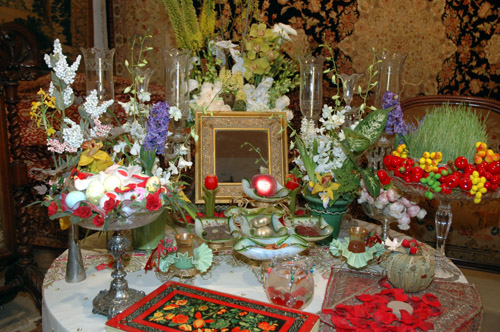
Cleansed inside and outside, we all should go to welcome the “beginning” with light, with a salute, and with purity. We all know all about the haft seen, that I’m not so kosher about, always placing cinnamon in just to honor Michael Ondatjee. My samanou, is not always samanou but something similar, i.e., sweet and brownish like molasses. Gold fishes and their upkeep are my husband’s passion; they stay alive for years; and when they die, it takes us one or two years to bring ourselves to buy another one. Honestly, we do not know if originally they were seven seen or sheen and what they were; and it seems that whatever they were, sheen or seen, the tradition is fairly new. Our Parsee friends from Bombay who left Iran in tenth century have no idea about this custom. But whatever we miss, we should not miss the fire or candles, one never “begins” without it. Also the flowers, pussy willows and forsythias and quince apple blossoms and, best of all, did-o-bazdid and plenty of kisses are a must.

Finally, sizdehbedar, is my husband’s favorites. We take our sabze’s to the lake, if it does not rain heavily or does not snow, with a big loaf of bread to feed the ducks and geese. He is a big believer in knotting the sabzeh. I will never forget the first year I met him, before we married, he invited me to take the sabzeh he had grown to throw in the river. In his apartment, what I found as sabzeh was three grains of wheat grown to ten inches high! We picked them up, all three grains, and went over Brooklyn Bridge, and we knot them with our wishes. His first one was for our dear country Iran (well!). The second knot was for my sister’s health (after twenty-eight years, thank Heaven and those three grains of wheat, she is fine). The third was for us (we got married six months later). With my wishes I cheated a little, I placed the residues of whatever hard feelings and grief and passivity and gloominess into the knots, hoping they would be washed away into the water. Throwing three grains of wheat from the height of the Brooklyn Bridge to the East River was not easy. We placed them in a tissue paper and placed some pebbles next to them to give them heft, then my husband very skillfully launched them into the water. Oh my God, you may not believe it, they landed so nicely over the water and were carried away smoothly. We both took it as a good omen. He is still a big believer in that.

Try it, I promise you won’t regret it.

Happy New Year.

* The division of the Fasli Calendar is different than our calendar. A year is divided into two seasons and every season into six months, every month into four sections, the first two being seven days each and the second two eight days each. The last five days are called panjeh and are not part of the twelve months. As a result, Chaharshanbeh is always the last day of the year. And no matter what, the year always start with Shanbeh (Saturday). (These names were given to them after changing to the Shamsi calander, i.e. while the tradition is old, the names are fairly new.)


To read the rest, click here.

Rumors of War: Bush and Yazid?

As March approaches, I cannot stop being worried about the rumor of a US war on Iran. Even though my good friend Cyrus, who I believe is the most accurate commentator on Iranian politics, told me that these threats are all rhetoric and nothing will happened, there are Seymour Hirsh’s most recent piece in the New Yorker and that article in the London Telegraph which can cause one to loose sleep. Unfortunately, we do not live in an open society (not in Karl Popper’s free-market sense, but in Bill Moyer's sense). We live in a new Dark Age; the light is the media, which is switched off. If you do not believe this, look at the front pages of the newspapers which keep a running tally of the men who claim to be the father to that Anna Nicole Smith’s child. And television? I got a glimpse of it on Sunday night before the Oscars, and I was so glad we don’t own one.


Turning to the Iranian online newspapers, I was amazed at all the comments on Shahram Jazayeri Arab’s escape from prison. He had been arrested on a monetary fraud charge during the last administration and his trial was a record-breaking television show in Iran during the Khatami’s presidency. According to those articles I read, since the present government did not have any use for his anti-reformist show, he was allowed to escape. The government was so anxious for him to get out of the country that it immediately announced that he and all his family are beyond the Iranian border so that people should not expect any follow-up.

The second big news was regarding the obscene questions about the life of the Prophet asked by the Ministry of Education in one of the teacher’s college entrance exams. (It is such a relief that the offender was not a foreigner and or a non-Muslim. Thank God he was not reformist either, but a full-fledged fundamentalist, one of their own.)

I turn to the blogs. There are few that I read every night. Sayyed Mohammad Abtahi’s nightly article is my number one barometer of calamities. His being a cleric and close to Khatami, his amicable personality, his extreme popularity which keeps every door open to him, his connection to a vast array of classes of Iranians, and his sharpness and courage, makes him uniquely capable of saying things that others are not able to. If he feels safe, I’m safe, and everybody is safe.


Abtahi’s last ten articles do not indicate even a remote possibility of war. He has written about the Jazayeri’s Great Escape and Batebi’s Humble Shirt (coming to a theater near you!), he wrote about writings memoirs, stereotyping, Khatemi-bashing, film festivals and Dehnamaki’s movie Emigrants, the above-mentioned obscene questions posed by the Ministry of Education, Ahmadinejad’s latest gaffe (a sixteen years old girl who built some nuclear something). But there was nothing about the war.


Massoud Behnoud is in England. Although this is a safe haven, he is not the kind of person to sit and watch the events passively. He has to say something. His last ten articles were about the Tehran University poetry reading to protest Batebi’s situation, about Espahbodan’s untimely death, about Iran’s movie industry and its founders, and about Ghaffary’s death. He has also written a few article about the negotiations over Iran’s nuclear energy program and the price Iran has to pay for being isolated due to it. But nothing regarding any war.


Another site which I use as my barometer is Ahmad Shirzad. He was the Isfahan representative in the reformist Majlis. He is very outspoken, extremely knowledgeable in nuclear physics, and a tireless activist. He would not sit idle if America were ready to drop the bomb. He knows for sure what would be the consequence. In his latest article, he invited Ahmadinejad to a television debate over his claim that “even if we stop all the government’s programs for ten years and spend it all on nuclear energy, it would still be in our interest to do so since Iran would move fifty years ahead.” It is very significant that Shirzad would even bother to respond to Ahmadinejad if we were even remotely close to the war. Knowing him, I think he would raise a hell over it. He knows well enough that there won’t be any television crew to broadcast the debate and that no one would be interested in seeing the President is defeated, if the bomb is dropped on Iran.


There are other sites I read on and off: Emad od-Din Baghi, Mara‛ashi, Tajzadeh, Arghandehpoor, Mazroo‛i, Ebadi, and Rafsanjani. None of these sites indicate the war we hear about here. In above blogs and sites, there are several articles regarding the various interview or the results of talks or sanctions and their effects, but none about the possibility of war, a real war in which places get destroyed and people die.

I realize that I am just arriving at a conclusion by a process of elimination, or by some sort of reasoning. We have tried those methods before the Iraq war, and were all disappointed. Reason has nothing to do with politics. However, what I’m trying to say is slightly different. The web sites I read are not government-connected sites. They belong to individuals and activists. They are writing with different motives. That is why I think they are reliable and that is why I choose them as my barometer.


I do not think any of the above-mentioned bloggers and activist would write what they write if they remotely anticipated the possibility of war. I do not think that Abtahi would have gone to a film festival and laugh and write about it if he thought that the Americans were in the Persian Gulf ready to attack Iran. I do not think that Shirzad would have invited Ahmadinejad for a debate on television if he knew that all those fabulous monuments in Isfahan would (God forbid) be destroyed in the near future. I do not think that Baghi would have written about the people in Ahwaz who had been executed. I do not think that Tajzadeh would have worried about the government ignoring the laws that much, and of course Mazroo‛i is smart enough to know that economic plans are of no use if we are getting involved in a war with the US.


What do we conclude from all this? Are we all involved in playing a role in a fiction? Is there no war and our beloved governments are working willy-nilly together, as Christian Amanpour reported? Or there is another strategy? Or bunch of fools putting on an act in an abyss with the people following them?


We all know what will happen when we rely on each others’ weaknesses, when we bluff, when we think the other side thinks as we do, when we think we are all like each other. We think they all are like “me,” and when our calculations fail, we will cry “Va Mossibatta” (“What a calamity!”) if we survive.

Sitting down in front of my computer and reading online newspapers, and going to bed with a false reassurance that there will be no war, I feel guilty of the same error that has been repeated many times in history. I do not think the Japanese even remotely expected the shameless bombing of Hiroshima and Nagasaki. I have no doubt that Dr. Mossadegh would not believe that America would have acted as she did in 1953; he thought that America’s idea of democracy was the same as his impeccable idea of it, and that the Americans were just as committed to it. I have no doubt that that Shah never thought that Jimmy Carter would have betrayed him in broad daylight as the whole world looked on. None of us thought that America would do what it did in Afghanistan or attack Iraq. We all thought the rule of reason, justice, fairness, shame, etc. were credible enough to prevent catastrophe. Experience has shown us otherwise.


I argue that all these clerics in leadership position won’t sit with their hands folded and wait for America drop a bomb on us. They would do something; that is what they are there for; that is why we have the Vali Faghih, isn’t it? He is there to intervene in critical situations. He can ask this incompetent Ahmadinejad to step down. We have a big office of Maslehat Nezam with Rafsanjani in charge; are they not supposed to oversee the welfare of the country or system? Are not they supposed to take action if the country is in danger and the government is mishandling the crisis? I reason that if they are not taking any action, things are safe and secure. But what if he makes the same mistake I do? Of course the Islamic Republic does not follow my line of reasoning, but it could follow the Imams’. Could it be Imam Hussein’s for example? It may.


Imam Hussein went to war with the Caliph Yazid with only seventy-two people, many of whom were his families, including women and children, who were not skilled warriors. Did he not know the consequence? Did he not know he would get defeated? Or did he know and did it anyhow? I think very likely he thought the same as we are all thinking and many others before us. More likely he did not think Yazid capable of such sacrilegious brutality. He relied on something that he was not sure of, a vestigial sense of decency, righteousness, fairness or even shame in Yazid, who had none. Are we not all following the same footsteps again? What if we are all wrong? Then is there always the option of playing the martyr? Is that what we are heading for?


Let’s see. I’m safe as long as Abtahi and Shirzad’s are not worried. They are not worried probably since Rafsanjani and Khamanei are not worried. All those ruling clerics are not worried because they think America won’t do anything so stupid. Am I right? Is this what they are learning from the epic tragedy of Imam Hussein? Is that what is going on? Why not? We all are assuming at this point and hoping that all decision-makers think like us and wish as well as we do. They may not.


We the people in the world, with all our intelligence and cleverness when it comes to certain things, are not acting intelligently. I cannot believe we have left the world to George Bush, who probably models himself after John Wayne, and Ahmadinejad, though he does not need any model, being a model by himself, who models himself after George Bush. They are bluffing and mishandling and doing meaningless things and together walking into the abyss and taking us with them. Would anyone survive to cry “Va Mossibata”?


PS: I notice that some American military have come out against any American adventure in Iran. Visit their website at http://www.stopiranwar.com/.


To read the rest, click here.

Sunday, February 25, 2007

An Iranian Petition against Holocaust Revisionism

An open letter by a group of Iranian academics, writers, and artists regarding the Tehran Conference on Holocaust Denial


Over the past year or so a number of official and unofficial public statements have been made in Iran denying the genocide of Jews during the Second World War. The culmination of this trend was the widely publicized, so called “International Holocaust Conference”, held in Tehran in December 2006. Given the serious moral and practical implications of this trend, we, a group of Iranian academics, intellectuals, writers and artists, find it imperative to take a public stance on this issue.


  1. Today, several decades after the end of the Second World War, testimonies of the survivors and researches carried out by numerous historians have unequivocally confirmed the Jewish genocide during the World War. Besides the genocide of the Jewish people, historians have also spoken of the mass murders of the gypsies, the Slav people, potential and actual opponents of the Nazi regime, the disabled, prisoners of war, and even in the closing days of the war, the incapacitated German soldiers. These crimes were committed widely and in various ways, including through firing squads, starvation, long hours of forced labour in concentration camps, and massacres in the gas chambers of extermination camps. The extensive material evidence, the confessions made in the Nuremberg trials and other trials that took place after the war and the testimonies of the survivors establish the veracity of the accounts beyond any doubt. Moreover, the voluminous anti-Semitic and racist literature left from the Nazis shed light on the roots of this inhuman hysteria. The accuracy of the accounts has been acknowledged by many academic, political and religious authorities including the Catholic Church. They have all condemned these crimes. On the other hand, there have always been a few individuals who have denied the genocide of the Jewish people or questioned its significance, through casting doubt on the number of people murdered or the manner in which they were put to death. The majority of the speakers in the recent conference held in Tehran were from amongst those few. This conference did not meet the requirements of an academic forum. The speakers in such a forum should be chosen by specialists of the topic on which they are to speak (in this case, historians). In an academic forum both sides of an argument should be invited in order to engage in a discussion. Only in an open discussion involving all sides of a debate one can hope to see the presentation of substantiated claims. In the absence of such academic standards, in the conference held in Tehran, mere unsubstantiated claims were put forward, mainly for propaganda purposes. Moreover, the proponents of these claims were invited to the conference without paying any attention to their background which in some cases was outright racism. The presence and the appalling speech presented by a former Ku Klux Klan leader, a group infamous for its involvement in hate crimes against the African Americans, was a result of this recklessness.


  2. In the history of mankind, there have been dark events that have treaded upon human values and broken basic moral principles in such a way that make them distinct from other comparable events. The scars left behind on the face of humanity by these events are irreversible and talking inconsiderately about them can only be described as rubbing salt into the wound and exacerbating the pain. This is in particular true of the crimes committed during the Second World War, some survivors of which are still among us. The sensitivity of the issue could be seen in the reaction shown by the people and the governments of the Eastern Asian countries against the stance of the current Japanese government in regard to senior military officers of the War. Those who perpetuate the discourse on Holocaust denial ignore the feelings of the people directly affected by this event. These people include, among others, a group of our Jewish fellow citizens in Iran.


  3. One of the main claims put forward in this conference was that the Holocaust, as a historical event, has been used as a tool to justify the policies of the state of Israel. This claim was expressed in particular by a group of Jewish religious scholars who according to their reading of the Holy Scriptures opposed the existence of the state of Israel. Such claims are at best unhelpful to the cause of Palestine. The creation of the state of Israel on the lands of Palestine has its own history. No matter what political position we adopt regarding the creation of Israel and its further expansion, the historical evidence for the Holocaust remains intact. The fact that since the inception of the state of Israel many crimes have been committed against the Palestinian population does not provide moral ground for the denial or undermining of the genocide of the Jewish people. Acknowledging the Holocaust does not lead to the disavowal of the rights of the Palestinians, nor does its denial or undermining strengthens the case in their favour. The Palestinians, like all other nations, have a right to enjoy their livelihood in their own independent state. This right has nothing to do with the denial or acknowledgement of the Holocaust. Claims such as those that were uttered in the conference held in Tehran, can only work to the detriment of the rightful cause of the Palestinians and the efforts of the proponents of peace in Israel.


  4. Forgotten amongst all the sensationalism in the Iranian media accompanying the conference, was the bitter reality that the undermining or denial of human suffering for the sake of making political points – whatever they might be – will inevitably lead to moral degeneration: a moral degeneration that makes any judgment on the wrongfulness of the murder of the innocent dependent upon its political reverberations; a moral degeneration where by questioning the number of the victims, it fails to realize that “whoever kills an innocent, it is as if he has killed all mankind”.


We, the signatories of this letter, are of the opinion that such “conferences”, more than anything, harm the academic image of the Iranian universities. We believe that conferences like this do not help the cause of the Palestinian people and only provide pretexts for the warmongers in the region. We are of the opinion that holding a conference in Tehran in support of the denial of the Holocaust has perpetuated an immoral stance that seriously endangers the culture of peace and the peaceful cohabitation of human beings.


  1. Babak Ahmadi, Writer and Translator (Iran)

  2. Emad Baghi, Writer (Iran)

  3. Kaveh Bayat, Historian (Iran)

  4. Maziar Behrooz, History Department, SFSU (USA)

  5. Mansour Bonakdarian, University of Toronto, Mississauga (Canada)

  6. Rama Cont, Columbia University (USA)

  7. Khashayar Dayhimy, Writer and Translator (Iran)

  8. Kaveh Ehsani, University of Illinois at Chicago (USA)

  9. Farideh Farhi, University of Hawai’i at Manoa (USA)

  10. Laleh Ghadakpour, IRIP (Iran)

  11. Arsalan Kahnemuyipour, Syracuse University (USA)

  12. Ramin Karimian, Translator (Iran)

  13. Arang Keshavarzian, Connecticut College (USA)

  14. Azadeh Kian, University of Paris 8 (France)

  15. Morteza Mardiha, Writer (Iran)

  16. Ali Moazzami, Writer (Iran)

  17. Mohammad R. Moeini , UMass Amherst (USA)

  18. Mehran Mohajer, Photographer (Iran)

  19. Hassan Mortazavi, Translator (Iran)

  20. Mohammad Rezai-Rad, Translator (Iran)

  21. Kian Tajbakhsh, Researcher and Sociologist

  22. Mehran Tamaddon, Documentary Filmmaker (Iran)

  23. Farzin Vahdat, Vassar College, NY State (USA)

To read the rest, click here.
Tuesday, February 13, 2007

Imagine...

Imagine…

I know, I know, John Lennon has come and gone. What we mean is: Imagine the day your son, your brother, your husband, your sister, your wife or your daughter kisses you and goes for war. He or she goes to bomb your mother, father, brother, sister, aunt, uncle, nieces and nephews, your old neighbors, the baker in the next block or the officer in the police department or the ticket agent in the travel agency or the family doctor. Imagine the day that the grave yards where your parents are buried or the school you attended or the hospital in which you gave birth to your child is bombed, and God forbid, the contamination! Imagine. Just imagine. Only imagine.


It does not matter where you come from or what your political position is. It doesn’t matter if you are monarchist, republican, nationalist, or reformist. It doesn’t matter if you are Iranian or Korean or Puerto Rican or Armenian or Jewish. Just imagine. Just imagine.

What would you feel afterward? How would you look at the face of your loved one and say, “Well?” Well what? What would you do? What would you say the day after?

Think a few minutes. It doesn’t even matter if your response is in accordance with our taste or not. The important thing is that we are all entitled to be heard and ought to be heard. We do not need to be politicians, academics doctors, lawyers, or executives, as long as we are one way or another related to Iran or an Iranian, it is enough. Let our governments (Iranian as well as American) know what we feel. Your message could be a word, a short sentence, a poem, a story, one or a few photographs, a clip of film, a painting, an essay, or a speech. No insults, no abuse. Only let us be heard.

We Iranian-Americans living in the tri-state area want to organize a marathon of Iranian and Iran-related voices on March -- in New York City. We are trying to send a message to the Iranian Government as well as the American government that we are here and that there is no sharp line between Iranians and Americans any more. In fact, that sharp line ceased to exist long ago. We all are the habitats of one planet and the world is more interconnected than fifty yeas ago. The war-mongers should know that if it is hard to define who is American and who is Iranian, it is harder to define the borders. Where Americans are going to bomb, some other Americans will mourn over.

Let us know if you would like to be part of this marathon.

You do not need to be Iranian or of Iranian descent or related to Iranian by birth or marriage. You can be from any ethnic group but knows an Iranian in one connection or another: You might work with or work for an Iranian. You might have a girlfriend or boyfriend who is Iranian. You might have an Iranian teacher in high school or college. You might have bought your wedding rings from an Iranian jeweler. You might have had your life saved by an Iranian surgeon or an Iranian doctor might have brought your child into the world. You might have some historical, architectural, or some other cultural interest in Iran. You might have traveled to Iran as a tourist and experienced Iran’s famous hospitality. You might have some literary or artistic interest in Iran. You might have a humanistic interest in Iran. Please come and share your sentiment with us. Let us know what you expect from the American government or the Iranian government. Let us stop the war.

If you are a musician or some other performer, we would particularly welcome your lending this event a touch of culture.

We can help you with accommodation but not transportation if you are not living in tri-state area. Send us your message and tell us something about yourselves, your age, your background, your gender, etc. We can arrange for your message to be read.

Send us email at minazandsiegel@yahoo.com
To read the rest, click here.

A Letter to Dr. Zarif


Iranian Ambassador to the United Nations

February 11, 2007

Dear Dr. Zarif,
I heard you today on National Public Radio’s All Things Considered. I was really disappointed by your talk. Was it really necessary to put your reputation on the line for Ahmadinejad? Is he really worth it? Why did you need to say that the Holocaust Seminar was planned during the previous administration? Do you mean that during Khatami’s presidency there had been a plan to organize a conference to deny the Holocaust and that Ahmadinejad felt so faithful to the Reformists that implemented it?


Why did you say that David Duke applied for a visa where the Iranian government did not have embassy to check his background? Why was he invited to Iran for such a conference in the first place? What other credential does he have besides role in founding the Knights of the KKK and as a professional Holocaust denier? If Iranian intelligence is so lax that it could not find this out, then Iran is indeed in serious trouble.
Your boss, Foreign Minister Manoucher Motakki, send a message which was read by his deputy in the opening day of conference. It declared that the purpose of conference is not to deny or confirm the Holocaust, but just to investigate it. Mr. Abtahi, in his blog, replied “Why do we need such an investigation at such a high financial and political cost? Why should we be even concerned about it at all? This is an event which never concerned Iran.” He is right of course. It is interesting that you did not even feel the need to offer any sort of criticism or apology, but were dismissive of this kind of adverse publicity.
I have heard that your service to our country in the United Nations will end this spring. Why couldn’t you have stayed out of Ahmadnejad’s mess. Let his own people clean after him. It is easy for Ahamadinejad to forget that he does not own the country, that he is only a public servant and is there for a little while, but you do not need to be reminded that you are representing us and have to have our interests in mind. Please, Mr. Zarif, please, respect that trust which is placed in you (by the previous administration, by the way!). Remember that once you lose your credibility, you have lost it forever. Please do not loose it for Ahmadinejad’s sake He is not worth it.
Respectfully yours,


Mina Zand Siegel
To read the rest, click here.

Massoumeh Ebtekar

Masoumeh Ebtekar, Iran’s Minister of Environmental Protection during President Katami’s second term, was on the front pages of online newspapers this week. In commemoration of the anniversary of Ayatolah Khomeini’s return to Iran, she wrote an article “Neauphle le Chateau.” I read the article expecting some forgotten anecdotes or some of the Imam’s words of wisdom which might have been overshadowed by the excitement of the Revolution, like some of those delightful stories that Mr. Abtahi writes once in a while on his website. (Indeed, his story about the Imam during his airplane journey back home was wonderful.) Much to my disappointment, the article was just covered with bragging about how privilege she was to have met the Imam and recited prayer behind him. One piece of bad news for Ms. Ebtekar is that thousands of people who did not even know how to pray (whom I knew personally) and many others who were not even Moslems, including Bahi’is, were among the people who had that honor. What the reader like me expects is to really hear Imam Khomeini’s voices and message, his real and simple words. Unfortunately, the man who within a short period of time managed to be elevated to such an exalted position as Imam is still unknown to many of us. I do not even make apology to say that a year before Revolution, one of my neighbors, who was a devout Moslem and the only one that I knew as such, knocked on my door in and asked me if I knew who Khomeini was. I said yes, and told him that he was a cleric who was in prison in Shah’s time for his anti-land reform protest and that while in prison, he was promoted to the rank of ayatollah, thanks to Ayatollah Shariatmadari and his lawyer Mr. Rasekh (oddly enough a Bahi’i). I told my neighbor that I thought he was dead because he was suffering from some sort of cancer. He was amazed, since he didn’t know even that much. As far as I know, after revolution our knowledge did not improve much. He remained a source of mystery to many of us.

After Revolution, most of his speeches, unfortunately, were tinted with politics and did not reveal his real ideas and philosophy. It was just the occasional anecdotes and memoirs of those who have known him privately or have heard him out of the political context which have given us a portrait of him. I do not, however, recall any women’s perspective on this matter beyond the writings of one or two western reporters who had their own agenda when interviewing him. It was with this expectation that I read Ms. Ebtekar’s article, and I was disappointed.

The man who impressed her so much and showed her the ultimate way of salvation, the man who was do decisive in her life, the man whose she later became has remained as alien and unknown as ever. There is neither a single quotation from his speeches nor his conversations nor any words of wisdom from this man in her memoir. All she said was how privileged and honored she felt to have been graced by his presence—and honor she shared with thousands and thousands of others. Unfortunately, in spite of my two or three times a year trips to Paris, I was not there to have that honor, I would have gone there even though I had to look out of the corner of my eyes at others to know what to do when praying, and when and how to do “sojoud” and “rokoud.” I’m certain, however, that the experience would not have increased my knowledge of him either.

Writing a memoir, be it one page or a book, does not mean describing the course of events. Yes, thousands of people prayed behind him twice a day. But what does it mean but praying with him? What did it signify? And when do we want to go one step beyond the superficiality of events? Why don’t we try after some quarter of a century to know the man who had that effect in our history? So far, thanks, to Abtahi, we know for sure that he did not believe in forcing people to go to Heaven. If you, Ms. Ebtekar, know him a little better, you should just let us know. His thinking and his wisdom will surely help us all, including Ahmadinejad and Mesbah Yazdi. More adjectives and adverbs do not add to our knowledge. It just makes the image more crowded.


To read the rest, click here.

Tuesday, January 30, 2007

Prince Ebtehaj

Prince Ehtejab, by Bahman Farmanara


A film review


I saw an old Iranian movie in the Walter Reade Theater in New York’s Lincoln Center. It was based on an Iranian novel written by the celebrated writer Houshang Golshiri. The story is based on a fictitious character, Prince Khosrow Ehtejab, the last in the princely line of a dynasty which ruled Iran for a little over a century, before it was toppled by the Reza Shah Pahlavi I in 1921. Prince Ehtejab had been eye-witness to the latter part that dynasty’s history. He recalls his childhood memories of the ruthless way his grandfather ruled and how his own father bravely stood up to him, resigned, and withdrew from his service. Although he never gets the opportunity to rule, he is raised to be a prince. He recalls the tyranny under his grandfather. He recalls the brutal murder, unjustified punishments, illegal seizures, the keeping of men and women in captivity for nothing, the brutal condition of women, the cruel life of the harem, and the deprivation its inmantes suffer. However, there are things that he does not know. There are two people who feed him the past that he is unaware of. His beautiful, educated, well-read wife, Fakhr-ol-Nessa (Pride of Women) and his family carriage driver, Morad, who served three generations of this dynasty and was crippled in an accident while driving him. Fakhr-ol-Nessa tells him all she has read in the memoir of their ancestors, an almost entirely brutal history. Morad tells him all the events he witnessed with horror.


I have read the book almost thirty-five years ago, when I was obliged to like it, willy-nilly and whatever it actually meant. We were of the generation in which “liking” and “disliking” had nothing to do with our preferences. It was a badge of belonging to the “intellectuals”—or else. And of course I like it, and of course I liked the similar book “Blind Owl,” and of course I liked Fellini, and Sartre, and of course I like them because I should. I was becoming an intellectual.

I left the theater quite depressed. I was more worried about what the American audience would make of all this brutality and what message they would now file in their filing cabinet of Iran which was already bulging with misinformation. When I occasionally came across this information, I did not know whether to cry or laugh. And now this movie!

Anyhow, the movie was an excellent adaptation of the novel and stayed very faithful to the text. The acting was superb; it was a pleasure to see Jamshid Mashayekhi, who rendered the prince’s personality masterfully, and the younger Khorvash, to whom we theatre lovers are in debt as a pioneer woman in the field. (She played Fakhri, the personal maid to Fakhr-ol-Nessa.)

When leaving the theater, I told a friend “Did we really need this?” I walked into the street going to get the subway to go back to Brooklyn to prepare dinner; a few friends were coming from DC. Still quite depresses, I drifted into Fairway with the hope that the sight of tomatoes and peppers and basil would cheer me up a bit. “Don’t worry what these American will make of it, it is just a fiction,” I told to myself. That did not work either.

A lump in my throat, I came home. My husband asked how the movie was, and I gave him the report. I told him that I was glad that he did not come with me since it was too depressing. He had not read the book, so I told him the summary of the story. I then told him that by the time Golshiri wrote the book, Qajar dynasty was already a forgotten story and it is now totally irrelevant to us. Oh, yes “irrelevant!” That was the word in my throat. It pushed very hard. Alas, painful as it is, the story is still relevant. Relevant here, relevant there in Iran, relevant everywhere imaginable. That is why it was depressing and painful. Though, a brutal dynasty ended and the last prince in the line went to the depths of dead history, a new one was born, only with modern equipment and modern means to rule and govern and suppress all the more brutality, with more sophisticated weapons, including the chemical and nuclear. My husband came to the defense of the Qajar dynasty (he knows a few scholar from that family) and also in defense of the present situation which is not as bad. I granted him both, however I had to remind him of few cases of brutality of unfaithful husbands toward their wives (American), of existing polygamy (not just among the Mormans!), of the uncontrolled power that employers have over their employees, of the legal system which is in full support of the wrongdoers, and I let it go at that. He knew I would jump all over White House and two incomplete wars which turned the region into a bloodbath, and now with the threat of another war over Iran, the number of murders and the casualties in last five years in Afghanistan and Iraq, and also the crimes which were committed by Iraqis before the current wars using the chemical weapon given to Saddam by the Americans. And this is only small part of the brutality of which the American Dynasty was the architect.

The door bell rang, our friends came, a Pakistani couple. She is a journalist and had come back recently from Afghanistan with a magnificent report confirming that Karzai is not even the mayor of all Kabul, he is just barely in charge of his palace and its vicinity, that the Taliban are about, as for Al Qaeda, you bet! And the burka and poverty and war and fighting and chaos are all over the place. She even received a text-messaged death threat! What happened to the freedom and democracy send to them by George Bush? “It is on the way!” she said with a sad laugh.

“Where will her article on the visit get published?” I asked. “Well I’m looking around, but the newspaper editors do not have time to read it and they pass it to each other.” The report was only 15 pages double space. One can read it in fifteen minutes.

I felt bad for my husband. He himself is suffering from the injustices done in academia and that unbridled, incontrollabled abuse of power that is increasing every day. On top of everything, he has to put up with me and my readings of all these obscure events and their interconnections. I felt bad for him, he has to take all the criticism for all American’s wrong doings.

But getting back to Prince Ehtejab. It was a great movie, but I did not like it and I did not like the book either. Do we really need it? I can repeat the same comment again and again. Golshiri should know that we were emerging people, we wanted to change, we wanted to make a new world, yes, we were idealists. I do not like that realism of his. I did not like that life empty of love and compassion. I never understood why Prince Ehtejab should not have had the opportunity to improve himself. Should he not have given him a chance to depart from his ancestors’ history? Should he not have given him a chance to be a better person? Was it not cruel to make him doomed for no good reason? Golshiri can call it anything he wants, I just say I do not like the world which is doomed to be Evil. Even if the whole world is populated by Prince Ehatejab’s grandfathers I still recall many who were not like him. I wanted to hear the story of those that were good , those who changed for better, those who opened the windows and let the light in, those who could drag us into the street to demand goodness. I do not want the story about those who send us right to the sleeping pills bottles. I’m just talking about my preference.


To read the rest, click here.

Tuesday, January 02, 2007

Chelleh, Nights of Vigilance

Never before have I seen such an uproar over celebrating and assimilating our Iranian holiday such as this year with our Yalda night. Many articles and discussions about its relation to Christmas or tying its origin to Mithra’s birthday have appeared in Iranian circles. It was claimed and confirmed by Google that Yalda, meaning Birth, is in fact a celebration of the birth of the old Iranian Sun God, and was later adopted by Christianity as Jesus' birthday. While driving with our friend Reza to the Persian Tea Room to celebrated Yalda with a group of Iranians, we talked over that topic since I was supposed to give a short talk on it. Reza was even quite willing to abandon the whole idea of Yalda being of Iranian origin rather than giving up its relation to Mithra and Christmas. He thought it might as well be a Roman holiday based on Iranian mythology which was re-adapted by the Iranians.

It seemed that Yalda was the only name that my audience in the Persian Tea Room knew for this holiday. They were a little perplexed when I reminded them there is an Iranian name for this celebration, Chelleh. They were further surprised to hear that this holiday is not only one night but continues for forty blessed nights.


But it was I who was more shocked than anyone else when I found out that I must be too old to know things so ancient that no one else seems to know. One thing I know for sure is that none of our holidays relate to any event or personage at all. (I do not include the anniversary of the revolution or other Islamic celebrations.) They are just celebrations of the arrangements of the cosmos, and very few of them have any further cultural attribute in addition to their cosmological one. Chelleh is one of them.


I think it is mostly the cosmological nature of these holidays which gives them such legitimacy and privileges so that we Iranian never needed to demand, or to provide, further explanation for their existence. However, during my 33 years in the United States, I have observed that the natural legitimacy we used to feel these holidays had are not sustained anymore, with the exception of Naw Rooz the Iranian New Year. This holiday coincides with the first day of Spring, which, as the season of growth, buds, and blossoms, enjoys such a status as a self-explanatory holiday that we were at some point puzzled that January first is the Western New Year. It seems to many of us still that Naw Rooz is a more legitimate New Year than others.

But, the lesser holidays seem do not enjoy this legitimacy fully; we consider them just another occasion for festivity, devoid of their cultural significance. Like everything else which do not have a function, usage, or a meaningful place in life, they become subject to our discretion as to when and how to be used, and if it causes disturbances, we might do without.

To maintain the survival of these national heritages, Iranians in exile have come up with the idea of assimilating their holidays into the closest Western holidays, either in form or meaning or both. For example Mehregan is compared with, and defined, as thanksgiving for the harvest time. Tiregan is quite regularly celebrated on the Fourth of July (at least up to this date.) The same goes with this winter holiday of Yalda, or, as I insist on calling it, Chelleh, which is linked to Christmas.

I think the problem is due to two little words, jashn and Yalda

We translate the word jashn as celebration, which it is not equivalent to a " jubilee", but it is taken as such. The appropriate meaning for both (Jashn and celebration) is “to cherish” “to uphold” but jashn in our old tradition has the slightly more esteemed meaning of “worship.” A glance at the Zoroastrian calendar makes its religious intend clear. If that does not accord with our modern perception of religion, it is definitely due to the nature of theological religions (Islam and Christianity) rather than the mode of worship. It is fair to assume that all the jashns are, in fact, some sort of religious act and therefore bear a religious significance, though different than our concept of “religious significance” in i.e., Islam.

The other problem is due to the use of the name Yalda, and regarding it within the order of Western calendar. We can notice that it reads totally different. Yalda is Aramaic for birth, and occurs within just a few days of Christmas. So, the current link and all the myths surrounding it and the celebration of Mithra's birth appears unavoidable .

But lets call this holiday by its Iranian name, Chelleh, which does not mean birth? And lets see how it is set within the Iranian calender, relevant to the seasonal changes, and also lets look at the component of the details of this celebration, what to eat , etc. After all, why do we need to accord our holiday to the Western calendar? Did our ancestors worry about the adjustment of their holidays to the Western calendar? Did my grandmother in Yazd knew that Mithra’s birthday, or Chelleh, is just "few days to Christmas?"

Let us look back to the old name along with its roots and set it against its original background and setting, namely the Zoroastrian calendar.

We all know that it is the longest night of the year and that we Iranians celebrate this night by gathering together and eating melons and pomegranates and apples and oranges. We know we have inherited this holiday from our Zoroastrian ancestors. But the question is, why we should celebrate the darkest night of the year? Was not darkness the most signal attribute of Ahriman? Is not the darkness, virtually or metaphorically, denounced as evil? Are not we the creation of light? Are we not supposed to denounce whatever is not from the realm of good? Then why should we celebrate this darkness, which has dominated our life and is going to be around for a while (forty days). Why not wait for February 17 when the light starts taking over the dark nights? Would it not be more suitable for a celebration?

Jose Saramago, A Portuguese Noble laureate, in his magnificent book Blindness, describes the evil of darkness. He tells us the story of an imaginary land which undergoes a temporary contagious disease of blindness. People of the region gradually become blind one after the other to the last. Then a period of murder, rape, plunder, exploitation, hunger, dirt, disease and death follows. It is only after they all regain their sight that they realize what horrifying creatures they might become if they would be out of sight and live under the curtain of darkness.

Nor was darkness as metaphor used only in ancient times. We still refer to any evil deeds as taking place in the darkness. We attribute darkness to whatever we do not have access, and consider it very risky when “we operate in the dark”. We hesitate to make uninformed decision and are wary of anything which is not under the light. We still contrast the darkness of the hidden with the light of exposed truth.

For our good religion, it was neither arbitrary nor vain to enshrine light as the most distinguished aspect of divinity and darkness as the most abhorrent elements of the realm of Ahriman. Given all the doctrines of our old religion, it seems very natural to call for vigilance and awareness when facing an approaching evil. It should not be difficult to imagine that wintertime could be used as a natural reminder of that metaphysical and cosmological darkness standing for evil and it should not be difficult to imagine that these long dark nights could be used as a stage to practice and drill what we should do in preparation of defending ourselves when real evil comes.

The world Chelleh, which does not signify birth, could shed light on the ambiguity surrounding this holiday. The word has three meanings: 1) a piece of cord woven separately along with fabric and used to bind together a roll of fabric. 2) The cord of a bow which holds the arrow about to be released. 3) The 40 days of fasting which pious men would observe in the company of elders or priests in a monastery or forest in an isolated place to purify themselves. This practice was common in Manichean tradition and referred to in related literature (Balvahar). It is this tradition which lends itself to the various sects of dervishes’ practice of purification and Moslems’ forty days of mourning.


Setting this holiday, with its Iranian name, against the background of the Zoroastrian calendar (where the holiday originated) with its very distinct cosmological nature, we could very well think of this holiday as a prescription to guard our good kingdom of light and truth against the enemy if the situation arises. Is there any better time to practice our defensive skill than these long dark nights? And is there any other vigilance better than staying awake and alert (eating citrus fruits and melons)? Is there any other protection better than being together, hand in hand? Is there any other way to alarm our enemy, informing them that we are not sleeping, by making noise (e.g., by cracking nuts)? Do we not know that evil spirits are mostly hiding in the woods behind the trees (so that we knock on wood to avoid evil spirits)? Do we not know that evil’s sense of hearing is the sharpest of his senses
(گوش شیطان کر). And what about pomegranates and watermelons? These are two fruits held in esteem by Manicheans for their red lights and seeds inside. And the traditional food? Eggplants are valued for their seeds signifying the mission of spreading the seed of goodness.

I recall how in 1988, when George Bush’s father was elected president there were those who had the foresight to predict the approaching horror, and half of the country was immersed in gloom and doom, Noam Chomsky, in answer to a journalist who asked how we could go through another four years of darkness, said “People should do what they are doing already, getting together, talking, writing, raising their voices to make sure they are heard. They should let their opposite party know their objections.” Whatever we can say about Chomsky, being Zoroastrian is not one of them, but see how close he is to describing our observance of Chelleh nights?

P.S.

On 2006 when I delivered my talk and wrote this article, I could not imagine that so soon we would have a real Chelleh, that for forty nights and days we should be alert, wise, together, hands in hands, raising our voice, fighting the Darkness.

Dec 19, 2009


To read the rest, click here.

Sunday, December 10, 2006

The Clash of Civilizations

What are you going to do with a book that has no argument in it? I assume I can call it a My Bit Fat Statement. And then what do you do with a Big Fat Statement? I assume we can make a movie out of it and call it “My Big Fat Statement.” I thought about it but it did not work. The book did not have any visual potential. I discussed it with few others and we decided to dismiss it, but how do you dismiss a big fat statement by a Harvard professor? A biologist would say never leave a single cell or bacteria in an environment in which it breeds very rapidly. If not as a thinker or scholar, as a green peace advocate I feel oblige to give some response to it. I am talking about Samuel Huntington’s The Clash of Civilizations.


The book is about 321 pages and contains absolutely no arguments. Statement follows statement, datum follows datum. We go from the fishing industry in Alaska t to a Buddhist monastery in Burma. Who would ever go over those facts and figures? What would they prove? That they are wrong? The book talks about everything and nothing simultaneously in pursue of vanity, but the Harvard stamp entices me to go after it.


With a great effort I managed to come up with a few semi-arguments:


  1. Originally there were twelve civilizations. (I assume the rest have been eliminated in the battlefield of civilizations.) Mesopotamian, Egyptian, Cretan, Classical Greco-Roman, Byzantine, Middle American, Andean, Chinese, Japanese, Indian, Islamic, and Western.
  2. The first seven are dead
  3. Last five are surviving.
  4. At present, they are reduce to four.(Some combine Chinese and Japanese together as Far Eastern civilization, and some do not include Japanese at all.)
  5. All these civilizations are somehow based on religions. (Christianity, Islam Hinduism, and Confucianism)
  6. Since there are differences among them, there must be an everlasting clashes between them.
  7. At the present time, the immediate clash is between Islam and Western, or Christian, culture.
  8. If the West eliminates Islam, then it would be down to the West and China.
  9. As a result of clashes among the Civilizations, their number is reduced to fewer and fewer.

Does Huntington want to conclude that the surviving is the fittest? Not at all. He thinks the surviving is the one which must be the fittest, the one with the greatest will to survive, yet does not accept Darwinism. In the chapter on shifting the balance, he argues that Islamic fundamentalism is taking over, at least partially, because the West has neglected its aims and has become sluggish in fighting for its interests. The West must be the fittest. Why? Just like that!


Considering religion as a core of civilization is an outright error. Unfortunately one cannot argue on this issue with Huntington. He very conveniently has put aside whatever contradicts his theory. For example, pre-Islamic Iran is not even considered among the dead civilizations so one cannot argue that Iran at its peak of civilization, namely the Sasanian period for three centuries, as the greatest empire on earth, did not enjoy one unified religion. It was such a multi-cultural, multi-lingual, and multi-religious empire that people in the west of the country could hardly know the language and customs of the people in its east. Probably that was one of the most important reasons of the fall of the Sassanid Empire after the Arab invasion.


Here is another case of how he cherry-picks his examples to fit his theory. Rather than discuss India’s Gandhi, Huntington prefers to talk about Pakistan’s Jenna. He argues that Pakistan became independent as a result of a clash of civilizations among a bigger civilization based on religions, knowing full well that Jinnah was a secular man and used religion as a mere tool to justify his cause (his own wife was not Moslem). So even though Pakistan and India’s clash appeared to be based on religious, we all know it was not and religion was artificially introduced into it.


Sometimes Hungtington is flat-out wrong, as when he refers to Azerbaijan’s war with Armenia and says that Iran supported Azerbaijan because of their shared religion. The Islamic Republic supported the Armenians due to Azerbaijani’s agitation inside Iran.


Huntington uses the same methodology when using the data. The strongest argument he presents in the book is the relation between population growth in a civilization as a sign of its cultural hegemony. He gave various data to illustrate his point, but again, each data could be answered with a counterexample. When he tries to tie the powerful and influential to the religion or population numbers of that religion, the counter-examples repudiate his arguments and he ignores them. (In all the cases anywhere in the world the number of secular people grows much faster.)


Another argument Huntington gives to support his theory is that big civilizations either vanish or fall apart due to the clash between their minor civilizations. For this there are two sets of counter-evidence. One is historical. The big civilizations were not created as big. They become big by being taken over each others or by joining each other. One civilization defeats the other one and grows at its expense, or one allies with the other through dynastic marriage or for joint defense against a common enemy. In all these cases there is a primal resistance which leads to eventual tolerance. The adjustment of one civilization to the other is not caused always due to the superiority the superiority of one over the other. For example, when Iran was taken over by the Mongols, it was the Mongols who converted to Islam and not the other way around. Even when the Arabs defeated Iran, Islam up to a great extend became Zoroastrianized to be palatable to the Iranians and Shiism was born. Another good example is the victory of Greece over Iran and the period ruling of Parthian which resulted in which the birth of various Zoroastrian sects and the adoption of some pagan gods into the Zoroastrian circle of archangels, which persist up to today. Above all was the entering of Greek philosophy into Iranian culture as well as the influence of Iranian dualism into Western culture. A superior and victorious culture might very well be affected by the minor and defeated one.


Another counter-argument to Huntington is the fact that the collapse of big civilization is often simply due their size. Roman, Sasanian, and Soviet Russian are all examples of big civilization yielding to the natural and unavoidable rule of oversized unmanagble scale beyond the means and the power of the governments of their time, which were therefore bound to collapse.


In his chapter titled “The Global Politics of Civilization,” Huntington argues, “Civilizations are the ultimate human tribes, and the clash of civilization is tribal conflict on a global scale. In the emerging world, states and groups from two different civilization may form limited, ad hoc, tactical connections and coalitions to advance their interest against entities from a third civilization or for other shared purposes. Relations between groups from different civilizations however will be almost never close, usually cool, and often hostile.”


This repeated thesis of Huntington is neither based on any established theory nor is it supported by any relevant data or evidence. He repeats again and again that wars and conflicts are the results of differences in the values and culture. There might be validity to his argument if we consider a very broad concept of value and culture. For example, the desire for independence is a value and like everything else (for example, taste in music) could be part of the value system of that civilization. But is it not shared by other civilizations? Is it not desired by any country, Moslem or Christian? Once again Huntington insinuates his thesis as a theory which does not need to be proven by any means.


Another way to understand Huntington is to define civilization simply as a set of structural systems devoid of any content or meanings, i.e. the physical aspects of nation, population, military powers and economical means. In that case, when there is a disagreement, a clash is unavoidable. However it remains to be proved that if we could define the civilization as such.


Huntington’s aim in writing this book is clearly to provide a justification for United States military aggression towards other nations with economical resources which incidentally at this particular period happen to be Islamic countries (Iraq and Afghanistan). These two wars took place independent of any reason or justification, just like Huntington’s theory. Otherwise our generation can recall almost all the conflicts, uprisings, and revolutions which have taken place at least in last fifty years to have been geared to the conflict between modernism and repression which tried to either exploit the nation or keep it backwards. The progressive nature of these struggles, successful or not, contradicts all of Huntington’s claims. The greatest conflicts of our age were


  1. Iran as the greatest and the last revolution of the twentieth century. In spite of its Islamic form, it was an anti-imperialist revolution and a massive protest against an undemocratic semi-military state which was brought into power not by the will of people but by an American coup. The degree of it success or its failure remains to be seen. But present trends indicate that it is precisely its Islamic aspect which will bring it down eventually.
  2. South Africa’s anti-apartheid movement was not a religious movement. It was a racial movement and by and large was a successful one.
  3. The Soviet Union’s disintegration was not a religious uprising in spite of the Huntington’s claim that Moslem portion of its population was high. Moreover, none of its Moslem successor states appealed to religion for its independence and none of them have any sort of state-established Islamic institutions, let alone an Islamic government.
  4. World War II though was so racially motivated hardly could be called a clash between religious civilizations.
  5. In the twentieth century, there have been a plethora of conflicts between nations with the same religion, e.g. the Sunni Kurds and the Sunni Iraqi and Turkish states, the Sunni Taliban and other Sunni Afghan factions, to counter Huntington’s claim that conflicts are always a clash of civilizations or cultural values. Most conflicts are simply over access to the means of progress or wars of independence.
    Moreover, reducing a civilization to religion and religion to its apparatus and ritual, leads Huntington to see nothing but the clash among them. There is no civilization, big or small, which does not include a philosophical or ideological underpinning beneath the surface of all its practical means of productions, economic and political systems or even arts and sciences. In any conflicts among the nations, all these apparatuses might become subdued but the philosophy and ideas which are axiomatic in that culture enjoy the freedom to be only enriched further either by being influenced or influencing others.


    Sayyed Mohammad Khatami, the head of the Institute of the Dialogue among Civilizations, challenges Huntington’s argument. He believes that even a religion, significant as it might be, is only one aspect of civilization. In his book Philosophy and Thoughts Held Captive by Ruling Forces, he says, that “political powers might employ religion and use it to advance their aims without even being interested in the religion. What they use is in fact the superficial and structural aspect of the religion which they can use as any other institution to promote their needs and desires.” He claims that civilization as well as religion has two aspects, the structural and philosophical and the inspirational aspect. While the structural aspects might be used in various manners to pursue various purposes, the inspirational and philosophical aspects are immune from abuse and are the only developing and flourishing part of the civilizations and cultures.


    The problem of Khatami’s argument is the other side of the Huntington’s problem. Where Huntington fails to see the philosophical and inspirational aspect of religion and civilizations, Khatami ignores the power of all the practical and pragmatic necessity which is required for a civilization to survive. Oddly enough, his personal and professional experiences as a two term president of Iran in a very turbulent time has not allowed him to realize that his idea of a peaceful dialogue among civilizations even as a way out of the most trivial problems fails when it faces any reality. Even within his own country, even among the same civilization and culture, the dialogue has never worked.


    With all our interest in a peaceful solution to the various problems and the unwanted wars and man-made troubles all over the world, it is difficult to embrace Khatami’s well-intentioned proposals of the dialogues among the nations fully. His theory is unpragmatic and impractical.


    Khatami tries to make up for its lack of impracticality by advocating civil society and the rule of laws. Unfortunately, this solution has the same defect as the original dialogue solution. Two terms of the United States Presidential elections and the subsequence frauds and other scandals show that even in a democratic society the rule of law is not infallible. Our two theories fail to provide a meaningful explanation or solution to the problems that they trying because of their overly-ambitious scope. Talking about a grandiose subject such as Islam or Chinese civilization is so beyond the scope of our imagination and control that one tends to dismiss it. Dividing the world into four segments and using this to analyze war and peace would definitely not make it easy for a scientific approach. Science fiction might have a better chance.


To read the rest, click here.

Saturday, November 18, 2006

Nazeri, Parissa, and Siavash

Thousand of years ago when the earth was still flat and the world was a simple story with a beginning, a middle and an end and very finite, Iran was the center of the world and surrounded either with mysterious mountains or rivers and few enemy across the borders. There was a king whose name was Keikavoos. He had a very handsome son name Siavash. He had promised his son that he would give up his empire and leave him to rule as he wished. The day arrived when his son came of age and claimed the thrown. Alas, his father was not ready to abdicate yet and he put off fulfilling his promise by requiring him to fulfill a task before he could assume the throne, and when the task was fulfilled he added another and so on an so forth.

Not only did that promise remain unfulfilled, but through further deceit and lies, he first banished the innocent boy and then caused him to die a horrible death. The legend says that where Siavash’s head got off, somewhere in the border of his homeland, a plant called Siavash’s Feather grows that up to this day Iranian use for medicinal purposes.


Iranians still mourn this loss, and the procession is called Soug-e Siavash, indicating the intensity of their grief. Many of us are still wondering why Siavash wanted to rule and why his father refused to give up his kingdom. What was he so afraid of? After all, he had done his job and it was his son’s turn. What was so difficult that it was worth a father to lose such son?


Many years have passed since then. We now know that the earth is not flat and that the world is not so simple. In fact, it is indeed very confusing and muddled. With the advent of the computer and the internet and all communication devices it seems that the infinity of the universe is extended to our world as well. And with this infinity comes uncertainty and a sense of being lost. Iran is not the center of this vast world anymore and to tell you the truth, I even doubt if we ever existed—after all, it only takes one person from Yale or Harvard to assert or deny our existence and that is all.

The theme of the rivalry between father and son is not so unique to the Siavash, but it emerges in various form, again and again, through our Epic. this repetition, indicating the battle of old and new, is well rooted in our culture like many other old cultures. That the old and decadent have not given themselves willingly to the young and new, that the old has always resisted and, an more so, eliminated the new, is a repeated story, thought, no one ever learned from it. No one learned that there is always a younger generation who wants a new world order, and there is always an old one who desperately hung to the old and rotten order.


Today our story is just a little worse. The young is fighting with ones who want to go back even to way before their own order. In 1997, when the new generation and a new gender (women) voted against the old world order in a landslide, the old not only resisted, but forcefully eliminated them. In 2002 when students in the universities demanded their rights, they were thrown out of the widows or slashed with knives. The deputies in the parliament who wanted reform and justice were forced to resign.
In the 2005 elections, the elimination took different forms. In Khordad 22, 2005, women who demonstration for equal rights were beaten by police. In Khordad 22, 2006, the same group of women was brutally harassed and beaten by police right in front of a thousand cameras.


Today, as in old times, any demand or movement for a world new order is confronted harshly by resistance and the violence of the old world order. Of course the only difference is its scale and and its method.


As Siavash were assaulted, so were Mazdak and Mani, Nezam ol-Molk and Amir Kabir and Kasravi, the Bab, Dr. Mosaddeq and Rouzbeh, Bakhtiar and Ghasemlou and Sarkouhi and Ganji and thousands of others such as those lying is mass graves, like the journals Salam and Shargh.


The old castles were simple to protect and so were the old towns and lands. Today, the infinity of life makes it difficult due to the existence of many other institutions. However, there are always other alternatives, tortures, jails, solitary confinements, loss of jobs and other privileges and above all breaking pens and leaving people in absolute darkness.


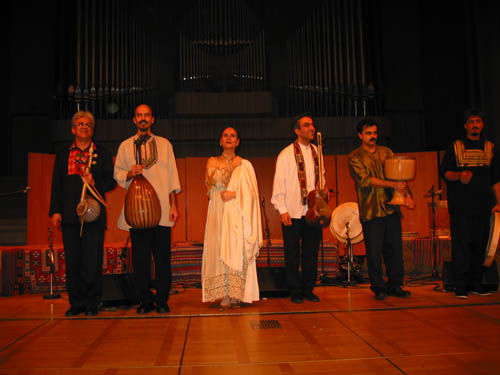
Siavash and his desire for a new world order is fully alive insofar as he is not alone anymore; we have thousands of them now and the old king needs an army of millions to kill them. I saw some of them last mount in Symphony Space in New York City. When Parissa appeared on stage with her ensemble, Dastan, I expected to listen to well-composed traditional classical Iranian music with all the dastgahs and goushehs in order, but when she started, I saw a tornado, a hurricane. I do not know what happened to that calm, reserved lady who appeared a few years ago on the same stage. She broke away from that old Parissa we knew. She went much further with a very strong voice, with confidence, with passion, and with real determination just to make sure everyone would hear her. She was not too shy to step out of the limits set for her by the previous masters or the traditions. She tore the hejab which was put around her by old rules; she even broke free from her womanhood, although she was free to be a woman. She was an authority unto herself to do what she wanted to do. She sang, and with her voice brought a sense of freedom to all of us. While she was singing I could hear a chorus of women singing with her. I could hear In Soroud-e Zendegi from every corner of the symphony hall. I heard Mansourehs, Noushins, Parvins, Shadis, Royas and Shahlas and others in every voice rising from the stage.
That night when we left, it was already late at night but none of us wanted to go home. We walked downtown from the Upper West Side. Along the way, my friend pointed at some large plums in the all-night grocery store and said “for years I wanted to grab one of these plums and eat it but I can’t.” While I was expecting some dietary explanation, she continued with an anecdote regarding a plum tree in her backyard which was raided by her brother against the arbitrary forbidding order of her father. She said that the scene which occurred when her father saw her brother bringing a bowl full of the plums into the room left her with such horror that she could never touch any plums. I do not know that I wanted to share her pain or if it was my own hidden pain which needed some company that I told her that a soccer game has the same effect on me when I remember how years and years ago, my brother was beaten by my father simply for playing soccer in a clay court in our neighborhood. He was beaten quite regularly, first for the crime of playing soccer with some 21 other boys whom my father could not run a background check on, and secondly for the crime of getting dusty after playing. I think it was the second crime which my brother could never defend or do anything about; there was no grass court in Tehran then.


Needless to say, it was not the first time that the two of us saw plums together or talked about my brother, but it certainly was the first time that both of us talked about the tyranny we both lived under, a petty tyranny within a system, within the government of a family, an institution which both of us cherish, the tyranny of a person that both of us respect and love and undeniably were both so in debt to. It was not these about which we complain, it was the tyranny, it was that unrestricted power, and it was the arbitrariness of their rules, that outdated mindless orders that we should follow without question. Later on, I was thinking what if one of us would have asked my father how one could avoid dust when playing in a clay court? Or how we should play soccer if there are not the right number of people playing? I was also thinking how my father would have responded to those questions. Could it be the reason that he would never let us to question was simply that he had no answer?
Last night I saw the Siavash Feather plant growing again, this time in the Asian Society.
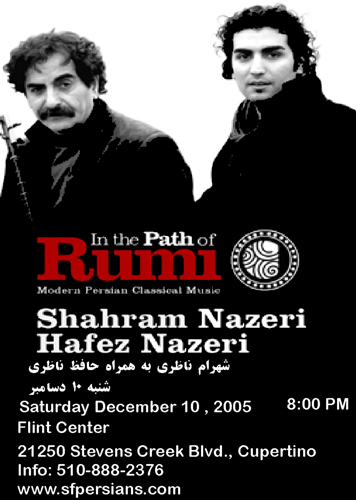
Shahram Nazeri and his son Hafez performed their “In the Path of Rumi.” I know Nazeri’s work and his effort to raise the voice of Iranian music for the last thirty years. But last night’s performance was not in line with what he had done for Iranian music before. He seemed to have fulfilled the promise that was given to Siavash after so much delay. Nazeri did something that was more like magic. He submitted to the new order of music set by his talented son, Hafez, without any hesitation and without any force. I could not imagine in my wildest dreams that any master of Iranian classical music could sing along with a western ensemble. And the strange thing was that he was so comfortable, it was as if it was the most natural thing for him to singing along with a cello playing beside him. And believe it or not, nothing catastrophic occurred. The earth did not become flat again and the day after sun rose as usual from the east. The only difference was that some of the audience who were not familiar with our traditional music listened to it with ease and enjoyed it.


Another thing about this concert: it was an acknowledgment by an old Master that it was time to leave the stage to a new one and even help him to play his turn. Nazeri did this task gracefully as would be expected from a Master such as himself. It was the beginning of a new era. Here’s hoping that our old politicians in Iran would hear this music. I am sure it would be very hard for many of them to accept that either. Last night I felt like I had sipped a Siavash’s Feather concoction, only just thicker, stronger, and more effective, yet soothing, just like Balm in Gilead.


To read the rest, click here.

Sunday, October 29, 2006

Mehregan in Miller's Theater

A celebration of the Mehregan festival was held in Miller’s Theater, sponsored by Iranian-American Society. This was the third program sponsored by this organization that I have attended.


The program consisted of two parts: A piano concert by Tania Eshaghoff and a vocal recital by Darya Dadvar. I was familiar with both of them.

I would like to reassure my nervous friends that I by no means intend to write about the musical aspects of this program for two simple reasons. One is that I do not know much about music and do not play any instruments. However music by nature deals with our senses and most of us rightly assume that a pair of ears with a little sense for harmony and rhythm and a little feel for melody is enough to listen to music and enjoy it. I think that much I can manage.

The other reason is that the program was consisted of two unequal parts. One part has the privilege of being vocal, which is more attractive, using poetry which has the double advantage of the magic of words and language combined with rhythm. If these rules are not universal, the are definitely true to my very primitive nature. So in short, it might appear that my ignorance and my bias disqualify me from writing this review. However, as I have promised, I do not intend to write about the music at all.

Instead I’m writing about the state of Iranian music in exile. In that respect, anyone who pays fifty five dollars for a ticket to a concert of two novice artists has a very legitimate right at least to say what was happening there. (We paid $45 for Parisa and Nazeri and Kalhor!)

In fact I feel obliged to write what I’m writing with the hope that those who know music (and I’m sure there are lots of them here) come forth and write and say what they must.

As it is, most of our young talented artists are left without a demand, challenge, and criticism, which undeniably plays the most significant role in the developments of any sort of art. Iranian art in exile particularly our music, is suffering tremendously from this want. I have twice been to Tania’s concerts. It is painful to me to see that her second concert was in fact few steps backward. Like the first, three years ago, she is simultaneously player, conductor, and composer. I am sure this is not unheard of in the world of music. However, like any sort of art, it takes time and experience to do what she is doing at this early stage of her life, without the necessary maturity and experience. Almost all the pieces she played (except one) was either composed or improvised by her. And the only piece which was composed by the beloved Iranian composer, Javad Maaroufi, fell into the abyss of improvisation after a few notes played. As far as I know, it is very unprecedented to give an entire stage to a novice to perform her own work; usually new talents are introduced gradually to the audience by performing small pieces within the programs of the more experienced and popular. The first performance of this young artist a few years ago in Symphony Space continued forty five-minutes over the time (one hour and half) given to her!

We Iranians have an expression which says every bride can enjoy her happiness for forty days. I think it is wise to think about forty-first day when the honeymoon of novelty and politeness and niceties are over. Then what? At some point, the audience wants a good piece of work whose ups and downs are in accord with their sensibilities and ears.

Not being a musician, I have no idea if this is a general state of affairs in this art form or is it only Iranian music in exile which is in such a disastrous state. We have Californian Iranian music which is so devoid of melody that one wonders how the performers remember to distinguish one piece form the other. And here on the East Coast it is improvisation which is killing us. Being involved and interested in the other sorts of arts, I do not know of anything which is allowed more free fall than Iranian music in exile. While it is easy to ignore Iranian pub music, with all its problem in the crowd of a wedding party, we can not ignore the defect of a music played in a concert hall.

I for one feel guilty that I am neither a musician nor a close friend or relative of these young artists or a member of their cliques or groups that organize such events to advise someone like Tania 1) to sit and play a nice pieces which are composed by known composers from beginning to end, 2) to keep improvisation and composition to a minimum until she establishes herself—these young artists should remember that the Art Masters first become masters then tried to change the course of tradition and not the other way around, 3). that those keys on the left side of the piano are there to be used and if she cannot bring up the sound which in required, the violin and cello will not make up for it, and 4) not all Iranians are from that generation that do not know good music from bad just because it is not tar or setar.

I’m here more critical of our fellow Iranians who are musicians (and I saw a few of them there in the salon) and definitely are in a position to write a review for this kind of performance so that these young artists can use their talent and energy in a constructive way. I hope that one day the Tanias and Halehs and Sousans will respect their audiences and not try to force them to listen to cacophony but to harmony. Creativity is not the same as chaos.

The other part of the program, the vocal by Darya Dadvar could be considered a good example of innovation mixed with passion and talent in a young artist who wishes to go beyond the boundaries which have been set for Iranian music for such a long time. Darya has studied in Toulouse. She has great love for Iranian music and makes her own adaptation of Iranian folk music and recently of some Iranian classical music. In her Mehregan performance, she performed a few classical pieces in Western classical style, which touched the heart of even the older generation in the audience. Her sensitivity to the emotional attachments of her audience is remarkable. This was shown when she performed the Iranian National Anthem Iran, Ey Iran! with her own interpretation without any distortion.

This performance by Dayra was less folkloric and less melodic than her previous one and the pieces were selected more from classical poetry and Iranian dastgahs, which lack that populists charm. Still, her performance mixed with her passion and her beautiful voice eliminated the gap which has separated Iranian Western music. Even the older people did not feel they were listening to opera because Darya made it easy for them. She simply sang from her heart and they listened.

I’m sure these young artists are able to reach whatever level of excellence that they desire. However, art is not just excellence. A good part of it is its soul, which comes from the artist’s very being. It is our responsibility to help them maintain that spirit and soul. As an audience we should attend. We should be present with all our senses and we should demand. As organizers we should make sure to arrange concerts so that they do not interfere with another, less expensive program ten blocks away with a giant name (Keyvan Kalhor) and an more titanic organizer (World Music). As some who have a share in this market, we should challenge and we should criticize. Let us be fair to our young artists; let them grow; let them to reach that excellence that they deserve. And as performers we should not think that the audience is just there to applaud. They are there to appreciate a good work. We should do our best to give them what they deserve, too. At this point, we are not doing our job as we should.


To read the rest, click here.