Sunday, March 23, 2008

Iran's Parliamentary Elections

“Once again, the people of Iran entrusted the Parliament to the fundamentalists.” This was the headline of Keyhan, the government’s publication in Tehran. There was a change to Saturday’s headline, “Under the wondering gaze of the world, the nation’s vote broke the enemy’s back.” Keyhan’s headlines celebrated what appears laughable but, sadly, is true: “A man wrestled with himself and three of them came first,” a revision of a joke in Sepidaran, Ahmad Shirzad’s blog yesterday, reflecting the reality of our parliamentary election.


I was not surprised to read that, once again, the Islamic Republic performed its miracle, once again we made the whole world dumfounded, along with amazed, bewildered, crazed, astonished, shocked, startled, flabbergasted, and any other synonyms one can find in dictionary, although in reality it was only once that we truly shocked the world (and that only by a narrow definition of world): the presidential election of 1997 which brought Mohammad Khatami to power, and we received political plaudits in some quarters twice again, once for Khatami’s second term and again for the last Municipal election of city councils. However during the past two and half years, our president has announced an earthshaking discovery or innovation or astonishing achievement that either “pierced the eyes of enemies” or “punched them in the mouth” or “slapped them in the face” every single week. Given Keyhan’s headlines as such and Ahmadinejad’s proclamation, there should not be left any eyes, tooth, or cheeks undamaged in the world.


While inflation has been rising, unemployment is out of control, and fraud and corruption are skyrocketing (Sardar Zarei’i’s prostitution story certainly beats our Governor’s story though), and housing in at its worst, the government campaign was ticketed on the supreme leader’s aim that this election would “show our unity to our enemy by our participation in a glorious election.”


The Government and the ruling clerics have very clearly defined themselves as “principalist and fundamentalist” without any further qualifications. They never doubted their own legitimacy, tried to prove themselves, or bothered to appeal to any authority to win over this segment of the population whom they appeal to. Since the Islamic Revolution, fundamentalism has self-confidently strode into Iran’s political arena and marched backward to the dawn of Islam and successfully established all the institutions, as well as a suitable discourse, necessary for an Islamic system to function and survive.


If Parliament is used by this government’s leadership, who does not even believe in democracy, it does not surprise me. If Khamenei would craftily call on the people “to participate in election to beat the enemy,” I’m sure he has a proper audience in mind which could be brought into this. Principalists realistically targeted their potential constituency, those who believe in Ahmadinejad’s halo, the imminent ending of the Hidden Imam’s Occultation, and the location of his well, etc., and developed a core of supporters by establishing suitable institutions and discourse among them. Since the first day of his presidency, Ahmadinejad relentlessly has supplied his supporters with what they needed: the articles of superstition, witchcraft, magic, and miracles touched by superficial aspects of the faith which could be found in abundance in every religion. His campaign on this aim started right after his election and continues still. On Friday, March 14, they all returned the favor and cast their ballots for him.


Reformists, in the other hand, like an army full of generals without soldiers, walked onto the battlefield expecting miracles.


When embarrassed, they accused the pricipalists of departing from the Imam’s wishes and ideas.


When defeated, they claim the victory for having 60% of the 104 seats, according to Mohammad Ali Abtahi's blog of March 17.


While 60% did not participate in the elections in Tehran, the stronghold of the reformists, they claimed they are the legitimate heirs to people’s trust.


While the majority of the people are inherently pro-reform, the reform movement failed to reach them and therefore to receive their support.


While there is a vast reservoir of potential supporters in a country of 75 millions, over half of which is younger than 35, the reformists are still awaiting for the birth of a constituency.


While non-fundamentalists and secular Iranians, who could have been absorbed by the reformists, are finding their own language and establishing their own institutions, the reformists still resort to the same language used by the fundamentalists and emulate their institutions, only a bit fancier.


For months, in meeting after meeting, the best they could come up with was President Khatami’s double-talk, like declaration, “Let us participate in election long-sufferingly, yet cheerfully.” I read this statement a few times back and forth trying to make a sense of it. Still it is unclear to me and many whom they addressed this message to and what it meant. Really, who was supposed to vote? Who wants to sent Zahra and Hasan Eshraghi to the Parliament? What for? What sort of reform they will bring to us? Who are they anyhow? The Imam’s dynasty? Turn back another thirty years?


While the reform movements’ most important achievement was sort of establishing and legitimizing the “opposition” to the ruling hardliners in the regime, what is left of it today is just a “long-suffering voice”. There is no trace of opposition left in it.


This election in fact brought the two segments of the society, culturally, politically, nationally, and even religiously head to head. If this conflict manifested itself in the messages sent by their leaders, “let’s vote to beat the enemy” vs. “let’s vote to show we are long-suffering,” clearly the reformist message did not reflect the voice of its potential supporters. When Khatami, regretfully, issued the above-mentioned statements, the real voice of the majority would call for a real challenge to the supreme leader, saying, “No, the Parliament is not a sports gym where we show our muscles to our enemies, the enemies that you created for us; that it is not place for us to rally to display our unity. We are united but not in your fraudulent front. Parliament is our home for our representative to work on our behalf to secure our interest and well-being.”


Obviously there is a vast cultural division in the country that cannot be denied anymore. While the present government and leadership have found its constituency among the masses who are equally happy with having a parliament as wrestling pit and willing to participate in the match, the reformist leaders simply evade the issue and declare failure cheerfully and invited people to “loose with a smile.”


In fact, the Principlists celebrated not only their own victory, but the reformists’ defeat. A simple look at the voting results will give a clear picture. In Tehran, which is the stronghold of the reformists, only 40% of all eligible voters participated and the top candidate was Adel Hadad, rather than any of the reformists. No matter how discriminatory and unjust the voting process was, there is no justification for this failure. Those 60% in Tehran who did not participate in the election could have cast their votes for all the reformist candidates and they could have taken all the Tehran’s seats in a landslide had the reform movement asked them to. Unfortunately, our reformist friends never reached out to the millions of existing Iranian who could have been their strong supporters; rather they addressed some idealized members of their non-existing party.


The party which came to power with 22 million real votes, crying loud that, “We are with you Khatami, we support you Khatami,” was reduced to next to nothing by the policy of being long-suffering and complaining of “others” and those “absent entities.” I sometimes thought they spent most of their time and energy wishing for some exorcists to cast a spell over those “evil entities.” After twelve years they have not been able to establish any unique institutions or discourse of their own to define reform’s nature. It seems they shied away from average middle class secular Iranians, those big “S” people, those big snaky “S” people who constitute at least 60% of voters and stayed home on Friday, those who really would cherish reform but have no place in the reformists’ mind or heart.


Reformists did not even use what was offered them even to a fraction of its potential. The pledges of 250 young and popular actors and actresses could have brought a few million votes to the reformists. (In the last presidential election, in spite of the serious boycott by almost all, Baran Kossary’s campaign brought one million votes for Mustafa Mo’in!) Instead of a clear message with a clear goal and purpose, the reformists send fuzzy, confusing messages. The wide gap between the reform establishment and pro-reform people could be narrowed if the party would have been willing to define the movement in a way to include those millions, and to employ a discourse suitable for this majority, even at the cost of losing some for whom the movement currently appeals in manipulating religious symbols.


Knowing that there are reformists who know of these missing people, I wonder if we, the middle class secular Iranians, who are the backbone of Iranian society, definitely the backbone of civil society, are ever going to be included as part of the society that the reform movement envisions; if at some point the reform movement quits sticking to the paradox that is created, if at some point they admit there is something essentially wrong in Islamic Republic that needs to be reformed; and if it begins to hear us saying, “No, going back to thirty years ago is no good, there were problems then, there is problem now! We want real reform!”


At this point, we are so far from all this that sometimes I wonder if reform is only a nominal party which must exist just to fill up as an alibi, just in the case!


To read the rest, click here.

Friday, March 21, 2008

Jumping over the Fire

`To the right, the family haft seen.


Every year, on the first day of Spring, Iranians throughout the world set up a table on which appear the seven esses, standing for the seven archangels (ameshspandan): sabzeh, or sprouts, samanu, a sort of wheat pudding which is very hard to make (and which is only present in spirit), seeb, or apple, senjed, the dried fruit of the lotus tree, seer or garlic, somaq, or sumac berries, and serqeh, or vinegar. A mirror, some coins (sekkeh), goldfish (also here in spirit), and a copy of the Iranian holy book, the Avesta, round out the display.


On the evening before the last Wednesday of the year, it is customary for Iranians to jump over the fire, saying "Zardiye man az to, sorkhiye to az man," meaning, "My yellowness to you, your redness to me."


Last night jumping over the humble fire I made in my backyard accompanied by my faithful affectionate friend Omar Khayyam, who had reposed under the step next to my good neighbor Anda, watching the fire with a frightened eyes, I noticed in spite of the horror I went through last year, I do not have that much anger or so many grievances to cast away.


As has been my little ritual, I pack all the dissatisfactions and unkindnesses that, like many, I have had to bear in life and bundle them together to give away safely in the warm glow of the fire on Chaharshnbeh Souri. I let my heart become warmer to all, even toward those who have not opened their heart to me in past. I let the good scent of the burning twigs wipe away the memory of occasional unkindnesses and unpleasantnesses. I even let the smoke rising from the fire cover up those unwanted bitter realities.


This year, although I did not have much in that bundle to give away, I had a heavy bag of good wishes, hopes and prayers for all: for the health of my sister Mariam, my very dear friend Lili, my neighbor’s daughter Ingrid, my in-laws Eugene and June Siegel and, it goes without saying, for my husband Evan.


I bore some dear friends were especially in mind. Cyrus, my dear friend who had been with me through thick and through thin these last thirty-two years, was especially in my mind. He had lost his father just two weeks ago, a very special man, an old National Front combatant, a conscientious journalist, a devote religious man and highly spiritual. My heart is with him and his family in such a hard time. He and his family were certainly in my prayers.


Last year we lost two distinguished Iranian women. Though I was not personally related to them, I still had a memorial salutation (and not a prayer—they were atheist) to them. They both were from the Iranian communist Tudeh party, Jaleh Isfehani, a poetess, and Maryam Firouz, a cousin of our popular prime minister, Dr. Mosaddegh.


Among our other losses were our two goldfishes that had been with us for five years. I got especially attached to them since one of them had some digestive problems and off and on I had to massage its belly; when one cares, love follows. They both had a very sweet disposition which added to their attraction. We lost them this past summer within one week from each other. I could not bring myself to replace them with another one, so this year our Haft seen is without goldfishes.


It also goes without saying that our best wishes go to the entire family and friends and their families, and mine was no exception. They are in my nightly prayers always and I did not neglect them that holy night, either.


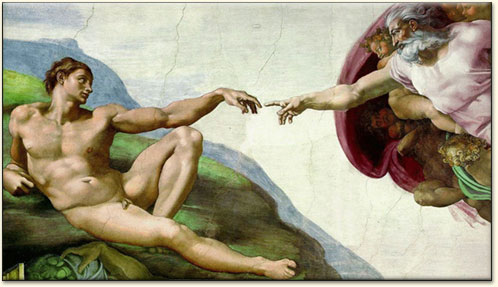
Of my bigger extended family, my country, my prayers were for the Iranian reformists. I prayed, and wished for their rebirth, I prayed for the emergence of a Michelangelo, someone with a little creativity, boldness, love, and truthfulness, to carve beauty out of that rock of Iranian political potential.


For my adopted country, the United States, I don’t know which is better or worse, Obama or Hillary. A few steps to the presidency, they are both sinking and dragging each other down. Well, my prayers to both of them. I hope one leaves the other alive, otherwise we will have to live with John “Bomb IranMcCain, who is not in my prayers, never!


Eliot Spitzer was in my mind since his crisis arose. I have quite a feel for him and his wife. I feel even the suffocating feeling of his desire to reach and grab the past and undo it. I hope with the wisdom he has demonstrated in his public life, and the love and care he must have had for his family, that he will be able to look into the situation, to evaluate his thoughts and feelings as to how he did it, if it was worth the suffering, and would he have done it if he would have given it a little thought. I wish him the blessing of the ever presence of Good Mind and Truthfulness, the sure protection against all malice.


Speaking of Eliot Spitzer, I could not stop thinking about these “love ladies”. I’m sure they all have their own stories and I’m sure in time, one way or the other, we understand them, as long as the person involved is not our husband. These love ladies, however, are all part of our society, those who sell love, those who beg love, those who solicit love, and those who offer it freely for a little of companionship, and those who may find a different name for it, all in all, they are doing something that they should not. I do not mean necessarily the business of the body and sex, I mean squeezing themselves into the corner of people’s lives where they do not belong, where they cannot find a proper and peaceful nesting for themselves, and sometimes ruin someone else’ nest as well as career, reputation, and life. I pray for them so they can find something worthwhile in their lives beyond their body to live on. I hope that our new governor will work towards legalizing prostitution, so at least as a profession, it would bring some security to these ladies, as well as open some doors to those who have nothing else to offer, thus reducing its ugliness and breaking its taboos, and hopefully it would not become such a weapon in the hands of a few to ruins people’s lives. It won’t make life prettier, but at least it will reduce much suffering.


Getting back to my little nest and family, I hope we find a job somewhere in Asia or North Africa or South America or even Quebec if McCain becomes president. It is very painful to be in constant fear of violation, stupid talk, meaningless political jargon, hypocrisy, and chants of “We’re Number One!” and even worse, the shame, the shame of being so shameless.


I prayed for Omar Khayyam, and jumped over the fire for him, since he


Iran Writes, Nancy, and Hakim

was afraid to do it himself. I wished him the best of health and prayed particularly that his hearth would become warmer towards our guests, mailmen, Nancy, and Hakim, my domestic helpers, for whose safety, among my friends, I prayed specially.


And finally I wished and called for the Farahvashis to see the glow of my fire, and find their way into our home, and not forget me here in Brooklyn, where there are but very few Iranians, and much less Parsis. I wish, if they do not want to trouble themselves to check in personally, not to forget to bless us for a life full of health, prosperity, good spirit, vitality, humility, and light, and protect us all from Evil.


With my warm wishes for a happy No Rooz to all.


To read the rest, click here.

Monday, March 17, 2008

Iran Writes on Press TV

Please click on this link. If you have any trouble, please contact us. To read the rest, click here.

Saturday, March 08, 2008

Thus Spake Imam Khomeini

February, the anniversary of Revolution is a good market for those who are still alive and shared the flight with Khomeini to Tehran, or were present in the Alavi School and participated in the firing squad show on its roof, to bring us anecdotes and present them like antiques to customers like me browsing and surfing online for something interesting.


This year, in addition to the general and generic words of the Imam’s wisdom on freedom, human rights, democracy, independence, plenty of special anecdotes or stories appeared in the memoirs of his friends, all related to the problems at hand: election and government turning to the military and security forces. Oddly enough, most of these anecdotes were narrated by the reformists, and not a single one by fundamentalists.


Among the anecdotes there was one from Ayatollah Nateq Nuri’s memoir:


“In the early days of the revolution, there was a rush of women to come to visit Imam. They all wore black chadors, head to toe covered; and many of them, in order not to get lost, tied their chadors together. They would go into a frenzy and emotional crying and sometimes fainted. We were very worried for safety and security; it would have been very easy for a bomb to be carried under them. But we knew that if we had told the Imam to bar women for that reason, he would not agree. We were also concerned about the lack of female paramedics to help in case of an emergency. Sometimes the Imam would go to the second floor to rest, and when these women arrived he had to come downstairs. So one day I told the Imam that these coming and going up and down tired him, but the Imam noticed my real concern and said, 'Do you think that the revolution happened because of my tapes or because of you? No it happened because of them.'”


I like this anecdote. If I were in the Imam’s position I would have said the same. As a matter of fact, most of the sayings attributed to him are simple, sensible, true, and almost the best, and many of them, as Iranians say, are “tooth-shattering.” Even the timing should not be objected to; today is as good as any other day. Even instrumental usage of these sayings, to corner the fundamentalist as a devoted followers of Imam, is justifiable up to a point, although it has been proven ineffective. But the important question remains as to how long we should use a failing method. I never expected of Ayatollah Nateq Nuri to ask Imam, “Well sir, if these people made the revolution and not me or your tapes, then why is it that there is no place for them in the government?” It never occurred to me that he would be able to ask these questions since this kind of dialog has never been the part of that generation’s discourse. However, thirty years later I do expect that young journalists and thinkers or even younger clerics, who constitute the bulk of the reformists, would take a critical approach, and substitute a dialectical or analytical discourse for the kind of discourse once fashionable in Najaf and Qom's seminaries.


Since the revolution, the Imam’s words have become a kind of syllogism by itself. Being dealt with as the absolute, they have been legitimized and accepted by all as ultimate truths that do not need any further proof or arguments. “The people’s vote is the ultimate criterion,” “Our politics is the same as our religiosity,” “Islam should come for the strength and survival of the Islamic Republic and not vice versa,” are all from this category. They all sound good, some of them are even self-evident, and some are universally accepted. It is quite irrelevant to discuss the content of the Imam’s words of wisdom which, like many of their kinds should be cherished by those who have a taste for them. Though, the troubling is the usage of his statements as documents and manifestos, as substitutes for law, as ultimate guidelines as how to run the country and how society ought to conduct itself. How long should a country rely for its basics and fundamentals on the saying of a man who considered himself very ordinary and who made a massive mistake in appointing incompetents to be in charge of the peoples’ life remains a question.


Not only are older clerics, who shared the Imam’s beliefs and ideas, but even young lay journalists and analysts still wrap their pleas for justice in the Imam’s words and appeal to his ideas to salvage the last vestiges of what is called the Islamic Republic before it completely turns into a military-security state or explodes into chaos.


All these cries for justice have fallen on deaf ears, with flat denials of the leadership’s spokesman, Hosein Shariatmadari of Keyhan who refuses every argument given by reformist by misquotes from the Imam or anyone else who might be of any help, and with a simple clear bold answer of Mesbah Yazdi who once said: “All this talk about the people’s vote and people’s rights are nothing but a marionettes show. We are doing our duty and nothing could or should keep us from our duty.” His callousness aside, there is a bitter truth in what he is saying. These men in the Guardian Council are given a nonnegotiable right to do what they are doing. Indeed, the reformists are fighting an unbalance and unequal war, armed only with the Imam’s words whispered in someone ears, against those who are given the master key to all the Imam’s army and treasure.


All this came to a head just days ago when Ayatollah Tavasoli, rest in peace, in a formal session of the Expediency Council, of which he was a member, during his emotional opening speech passed away due to heart attack. It was indeed a great lose to the reform movement to loose one of its main bodies in a high place. The speech that caused his emotional outburst was none other than the same old routine, nothing worth dying for. The story of the couple who claimed they had met the Twelfth Imam and were rejected by the Imam as “crooks” had been told last year by Ali Akbar Hashemi-Rafsanjani. Also the account of the Imam’s will barring military interfering in politics and taking sides with either party was the topic of Akbar Ganji’s article in Rooz Online several weeks ago. To argue against the militarization of government, Ganji, in his recent article The Government of Ahmadinejad and Ruling of Sultan, has invoked Imam Khomeini’s will “… the military should keep away from all the political parties, even the most Islamic one, and stay away form all the other branches of government. It is the only way that military could be trusted to defend the country.” (Ganji forgets that the main reason for the formation of the Revolutionary Guards was to protect the government internally against the possible internal opposition.) His invocation of the Imam was indeed very surprising from the man who boasts that he is a champion of a critical approach and defines himself as “dissatisfied intellectual,” one who would remain critical even if we would have the most democratic system.


As why should Rafsanjani wait so long to reveal his document, his correspondence, and his anecdotes about the Imam now or gradually as they are needed? I’m not surprised at all. That is our pragmatic Rafsanjani! But one wonders how a person like Ganji should wait so long to address such an important issue as the role of the military, and in this context, and in this fashion. That military should not get involved in the affair of government is accepted by many constitutions including ours; it is argued for, it is challenged, and it is proven as fair and just. While we all may accept and respect this principal, we are only bounded by it since it is an article of our constitution. If the Imam is especially emphasized it, that is his privilege; otherwise, it does not and should not have any substantial effect in its significance or its being honored. Making the case for this on the basis of its having been mentioned in the Imam’s will, in fact not only does not add to its value and its importance, but only reduces it to the triviality of whatever goes in one’s will. Indeed, as is the case with the laws governing wills, they are always subject to more scrutiny and further objections of the beneficiaries. It is a disgrace for documents of such importance to be safeguarded in one’s will. Indeed, the Imam’s emissaries do not do him any favors, either, by turning him into such an irresponsible role model of statesmanship for those who want to follow his footsteps.


The novelty of Ayatollah Tavasoli’s speech was in Hasan Khomeini’s recurring dream of his grandfather’s appearance in them. However, the reformists, using their last arrow in their quiver, not only exposed their despair but somehow acknowledged their defeat as well. Judging from the front pages of the newspapers, even the reformists’ press, this news could not arouse any sensation among the people, or breathe any fresh breath into the lifeless body of the reformists. It was business as usual. Khamenehi went public in Azerbaijan, his native Azeri-speaking and zealous Muslim providence, to urge Azeris to vote. He harped on the necessity of participating in the elections. It is interesting that he abandoned the commonly-used term “religious duty” as well as the call for “splendid participation” which detracts from the solemnity of the act of participating in election, and does not have any alarming ring to it; instead, he used the uncommon term mojahedat, endeavor or fighting for Islamic principals. (The close relationship between the term mojahedat and jihad, holy war, was probably meant to send a double message to the people as well as to the reformists.) It seems that while our reformists have lost even their last arrow for nothing, the fundamentalists are ready to take over new equipments.


I can not believe that it happened so quickly and so easily, as if it had been rehearsed a hundred times. Reading the newspapers online these last several nights, the mute reaction of the public to all the recent events, the blunt answer of Keyhan (the spokesman of the Vali Faqih) to Ali-Akbar Mohtashami-pur’s speech in the memorial service held for late Ayatollah Tavasoli, and calling the content of his speech as lie and fabrication; more crying and complaining by the reformists; the already semi-retirement of Mehdi Karrubi and his wife (at least according to the state radio, TV and Press), and finally the last-minute agreement of the reformists to participate in the elections in spite of all the humiliation brought upon them, Sayyed Mohammad Khatami’s embarrassing speech which was uncharacteristic of his usual profound talks calling on the people to participate in the elections as “cheerful victims” to foil their plot (!), I feel that the parliamentary elections would not have a better fate than the last presidential elections. I feel that one more time we have to accept the humiliation of being defeated unfairly, once more we are defeated and crushed by a coup rather by a fair competition, once more those who appear to be with us are turned against us, once more our generals naively picked up fake and rusted weapons in a serious decisive battle. And once more our leader surrendered with a fake smile.


Hey Mssrs. Reformists, get real! It is our destiny you are compromising. It is time for alertness and awareness. It is not the time for exchanging niceties. It is not a good time to take a nap; didn't you learn that from the last presidential election? It is not the time for day dreaming either. I hope and I pray to God that the inventory of the Imam’s words and tales soon runs out, I hope he appears in everyone’s dream every night and instructs them and then finish with that as well. Then we would both feel free. He would feel free of us hanging to his shroud and will rest in peace, and we would be free, knowing that the legacy he left behind is not the windmills of Cervantes and we can’t fight with them like Don Quixote. Indeed what he left behind is monstrous and dangerous as hell. We need something more substantial to fall back upon, like a good constitution with plenty room for amendments.


To read the rest, click here.

Friday, March 07, 2008

Pomegranates and Iranian Identity

Having a memoir, a novel and a collection of short stories and poems by young Iranian writes, all sharing pomegranate in their title, on my desk, I’m thinking, is there anything else we Iranian in the Diaspora could identify with? What is in this semi-exotic fruit which makes it so appealing to Iranians to uphold it as their national symbol? Is it just because its point of origin, Heaven, that we Iranian should be its sole owner? Is it its birthplace on earth, Babylon, though we were there as simple occupiers? Is it its red ruby color which is the color associated with light, the most prominent attribute of Ahuramazda? Or is it just being new in this part of the world which makes the pomegranate welcome wherever novelty is welcome? But pomegranate is not such a novelty and is not so unique to our Iranian culture; and using it as such an icon seems odd to me.

The fruit is indeed very new in the United States. I was here when it arrived some thirty years ago and I witnessed its growth to a full fledged fruit just less than five years ago. Now it is one of the most popular fruits used on Rosh Hashana, when eating something new is recommended. Yet, just few years ago my good friend, Deborah brought a few soup spoons to the table with a few pomegranates and looked at us wondering what to do with them. I suggested it should be eaten without a spoon.


Well, it is good to reclaim whatever that belongs to us, by naming it, registering it or placing our flag over it, where ownership is such a big deal. When President Bush delivered his famous speech calling Iran, Iraq, and North Korea the Axis of Evil, I was very offended. Not so much to be called such names, but over turf. The fact that someone whose religion does not even acknowledge Evil, officially, comes forth and call us Evil really bothered me. Does he know Evil? Does he know how it looks like or what it does? Where its abode is? No, he does not know Evil, but he has heard there is something by that name. He usurped and took over something which was left without a proper ownership. And worse of all, he called us Evil. He did not even know that we discovered it. We ourselves know the fellow, inside and out. First, he is hideous like George Bush, second he is deceitful like George Bush and third he destroys like George Bush. If we would have moved first and had written an encyclopedia of Evil, instead of all those nonsense leftist and rightist pamphlets, he would know that that evil fellow is our own discovery and should know that “the Mosque is not a proper place for...” as Iranian would say.


This is one good thing about moving fast and claiming whatever is at hand. In fact, after the Evil business I got very worried about Heaven and Hell. Actually, more worried about Heaven than about Hell. If we Iranian do not move quickly and stick our flag or national anthem there, one of these conservative evangelists in a quick coup might claim it for American. Then we will all need an entry visa and affidavits of support and so on and so forth; and, then it would be very difficult to get there no matter how good we are, no matter how weighty our bag of good thoughts, goods words and good deeds.


Really, why not Heaven, i.e., Behesht I mean? Why don’t we identify with that majestic place that we were its architect? There is a painting in the Zoroastrian Fire Temple Darbe Mehr in Pamona, New Jersey, titled City of Lights, by someone named Shapiro. The painting is something between surreal and naïve, and the design of Heaven is magnificent. There are circles of lights here and there, and Faravashies are landing in the grass landscapes like weird helicopters (looking a bit like Las Vegas, though.) What does she know about our Heaven? Still I’m so grateful that there is no foreign element there. But what should we do if she would have placed a blue and red striped flag with fifty one stars there? Not even one like the United Nations! Any how, as Iranians say, could we secure our belongings and not make a thief of our neighbor. I just said that for the record.


And the other thing which is rightfully ours is “truth,” in any form and any shade and any color. It is very fashionable these days to attribute lying to Iranians, the chief witness being our “taarof.” There was even one lengthy article in Irandokht’s blog titled “Why we Iranians lie so much.” The writer considered our taarof and even our expressions of affection as some sort of lie, expressions such as ghorban-e-to (“May I be your sacrifice.”) or “ghadamat roye cheshmam” (“Walk over my eyes.”) were considered examples of this, as if we are the only nation using these words and expressions. Never mind “you look great,” “how wonderful,” “I love you,” and “amazing,” which are scattered all over like leaves.


Anyhow, I mean that truth is ours. We were the first ones who decided that the creation is based on truth and the first culture that cast out falsehood, among whom righteousness is the first word of Iranian’s holy book. Truth, with all it’s ramifications, is not such a bad identity, though it may not have the glamour and attraction of pomegranates.


I do admit that truth or its consequences may not seem appealing as a title, particularly with its mathematical and logical associations. However we can always come with some poetic amalgamation such as “the birds of truth.”


Tangible objects or places come easier. Let’s see if we can find any other icon for our identity. What about the harp? It was used by King David, true, but it is the oldest instrument we know in Iran. It appears in Iranian miniatures and we have artists associated with, I’m not sure which one, Barbad or Nakisa. The instrument is very good looking and fancy, with all its curves and strings look really elegant. It is uniquely women's instrument and I do not know exactly why. It might be just the position that it should be played, like a mother hugging a child or combing her hair, or kissing a lover.


The tar is another instrument which is becoming very fashionable and is popular among the women. It looks good and has a very warm and roundish pleasant shape which could be very sensual. (Just do not think about Khamanehi! I don’t know who placed it in the same category as tar. If I had the authority I would have de-tar this instrument. Any how it seems the Chinese had that instrument long before us.)


The daf, also, is very Iranian, but I think it is hard to be used as a symbol of identity. It does not stand up and does not have such a strong invigorating character, and by itself is not such an instrument. It does not posses enough independence which is such a necessity for today’s life, literary or else. So let's forget about it.


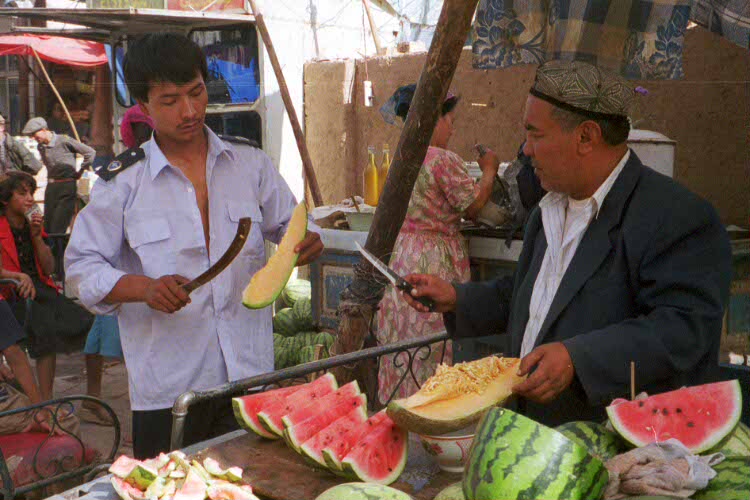
Among the fruits, watermelon is more Iranian and more symbolic than pomegranate. It was the Manichian fruit, for its self-containment, its red color inside, its being so juicy, and its seeds. The Prophet Mani himself liked it very much and it is still a symbol for alertness and awakening. Years ago, Jackie Kennedy suggested a photograph of three inexpensive Indian silver plate tumblers—three rupees each, filled up with watermelon juice, to be used for the cover page of the Tiffany’s catalog. The tumblers were sold in an auction in Christie’s for eighteen thousand dollars when she died. I think the watermelon juice had something to do with it!


Quince is also a very Iranian fruit, though here they call it Chinese apple. Its change of color is more striking than that of apples, and if it is cooked properly, it can turn into a beautiful rich burgundy color, and its perfume is heavenly.


Talking of the burgundy color, grapes in its variety was one of the most famous fruits of Iran. Their story is lost in the mists of prehistory. The first historical reference to them goes back to the King Cyrus time, and indeed the vine itself is so majestic and the best device to make a harbor or to be used in porticos.


Wine, the magical product of grapes, is certainly an Iranian product. It was used both for its nutritious and medicinal value, as well as a sacrament. What makes it so divine is its process of fermentation, and its gradual change of its bitterness to sweetness.


Figs are ours. I assume Iranians had so much of it that when they designed Heaven, they planted it there. Adam and Eve used the leaf as there first to cover their privates. The fruit has quite a magical texture inside.


And finally, nothing is more Iranian than persimmons, with that undefinable color.


A whole range of flowers could supply us with the beautiful titles. Lilacs, roses, pansies, jasmines, violets, wisteria , and also trees, such as willows and olive trees.


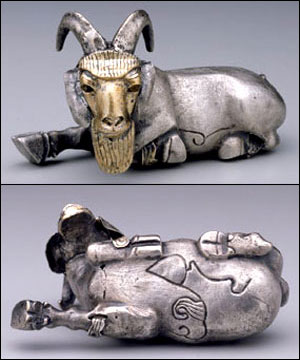
Among the animals, there are few beauties which are wonderful identity symbols. One is the goat. They were in west part of Iran and in almost every museum in the world there is at least one goat head of gold, silver or bronze from Iran particularly from Luristan.


My most favorite is the deer, with their beautiful eyes, elegant bodies and their dance like movements that could enchant anyone. I cannot imagine a map of Iran without some deer running through it. (I cannot resist mentioning that when my father married my mother, a tribal women from Luristan, and brought her to Tehran, he bought her a deer, so she would not be homesick.)


Horses are my favorite. They are beautiful and elegant. If we believe Herodotus, the horse is one of the three specialities of Iranians. (The other one is the bow and arrow. They are a bit dangerous but could be used rightly and elegantly--not by Dick Chaney--they could be beautiful symbols too.)


Apparently the Prophet Mani was the first painter who painted on the canvas or leather. He was the first one to use paint panel, which is such a pleasant, good-looking object.


And finally, the best of all are the literary similes, metaphors, and allusions which very easily could be adopted from our beloved poets. I recommend Saadi, since nobody's language has ever been as rich as his. And of course, among the moderns, Sohrab Sepehri who was such a magician when it came to similes.


At the risk of being called biased and prejudiced and even chauvinist, I cannot resist quoting Najib Mahfouz on something else which is very Iranian:


“Adam tiptoed warily into the room… He followed the left hand wall… Soon he found the table, he passed … He opened the door, and there he was slipping into the secret place that no one but his father had ever been entered… To the right was an ornate table and on it rested the thick volume, fastened to the wall with an iron chain… He crossed to the table and gazed at the cover of the book with its gold lettering, then stretched out his hand and opened it. He composed his thoughts and overcame his confusion with difficulty, then read in the Persian script: ‘In the Name of God.'”


I do not know if anyone can use it as a title, but those who have read Mahfouz's Children of Gebelaawi, know the book referred to is the God’s will. It is safe to assume that by Persian script he means the Avestan script. Well, on top of everything, we posses that honor as well. True, God has chosen the Jews, but He wrote His will in a language that only we Iranians could read. We have the legitimate power of attorney of God, we are heir to his will and with that goes all those words derived from it, heritage, heritance, legacy and the ninety nine names of God all belong to us! Hay!


So please buy a paint panel, use any two or three of all these and their variations and derivations and mix them together and borrow a few conjunctions and disjunctions and splash some nice color or perfume over it and come up with a nice title for your next masterpiece, and leave pomegranate, saffron, and Shiraz to those who used them first. Let your work come with an Iranian flavor and taste rather than just a name.


To read the rest, click here.
Monday, February 18, 2008

"... that love seems easy at first ..." -- Hafez
(Dedicated to my dear friend Nazy Kaviani.)

While waiting in a lounge in Beth Israel hospital for my x-ray results, I watched a replay of a DVD about Dalai Lama's meditation. It was titles Compassionate Meditation. If I understood the message of the Zen Master correctly, we all love, and are concerned about, people who are either related to us as family members or as friends or distance relatives. Some of them, like our immediate family, we spend plenty of time with, while with the rest we spend much less. Otherwise, we spend the bulk of our time with people with whom we have no relationship, those we are in contact with through work, not necessary our co-workers but even those who are affected by our jobs. Also, those with whom we share a common space daily, those with whom we drive side by side on the highways and streets, or those alongside whom we walk in parks and streets. Since we are not connected to these people personally, we do not even see the necessity of loving them, or even thinking about them. The teachings of the Dalai Lama suggest a kind of meditation to connect ourselves to these “middle” individual and love them as we love those related to us, just to guarantee peace and harmony. The DVD showed classes in Los Angeles where people would go to meditate, and, as is customary, they sat with crossed legs on the floor with closed eyes. Though their voices were not audible, I could hear in the back of my mind the sound of ommmm.


I watched the DVD and fell back into my armchair and whispered to my self ommmm. “What does ommmm mean, Mommy joun?” I asked myself.

This I repeated many times to myself to the memory of my dog who died two years ago. He was a stray dog whom my husband found one Sabbath night in his way back from synagogue. I was getting dinner ready, and waiting for him to return, when he called and told me I should take the car to the nearby college to bring a lost dog home. By the time I arrived, the police and university guards were trying to catch him (not my husband, the dog!) Well, they would not let us to bring him home; we even had to lie and sign a form saying that we knew the dog and his owner. (New York City in those days put large old stray dogs to sleep.)

We brought the dog home. Being a large mix breed of German shepherd, husky, and Doberman and few others things, being mature, male, ill and badly infected with worms, he was not adoptable. We had no choice but to add one more head to our household of four to become five. We had two little dogs (Mercutio and Ginger) already. We called him bill clinton. (Yes all lower case, the most fashionable in graphics!) We gave him this name since he was very intelligent and very handsome and indeed very manipulative. Neighbors called him mr. president (all with lower case, I guess.) In addition to taking care of his sicknesses, we had to chip him so that he could be retrieved if lost, and also to neuter him. The veterinarian’s treatment bill reading “Bill Clinton neutered” could have made headlines!

Before long, all three got to know each other and their boundaries. Though he was much bigger and stronger and could impose his will upon them, he gave them the right to have the privilege of having everything first. He would stay away and let them drink first or grab the first piece of treats, or to come to us first when we came home. He was very protective of them and stayed behind the fence with his ears pricked when my husband would take the little ones out, and listen to their barking as if to make sure it was out of playfulness rather than pain. Plato was right after all to say we all should learn citizenship from dogs!

He very clearly did not like Mercutio (I think he was jealous of her being much smarter and more intelligent.) However, he liked Ginger, who was just cute and a sort of a beach bunny. Once, when I ran after Ginger to scold her (she was in the habit of tunneling under the fence to the neighbors house), clinton came and pushed me aside and guided Ginger to the kitchen under his bed and then, with pricked ears, stood in front of me very boldly, as if to say, “All right, any problem?”

His thoughtfulness and concern was not limited to those with whom he packed. Indeed, he was very gentle with children. One night when we had my husband’s little niece and nephew in our home, the kids insisted on feeding the dog everything including scallion and parsley. The dog liked neither of these bitter herbs, but to please them he ate whatever they gave him. He threw up later, but did not complain. However, once my husband’s thesis advisor, who happened to be an athlete, a professional mountain climber who had climbed Mount Washington, was our guest and by chance came to the kitchen to see one of my artifacts, clinton did not approve the visit; to our embarrassment, he jumped at him and ripped his trousers. I took it as statement: “Mount Washington is one thing, but this kitchen is mine!” I think the main reason was his strong huge body and his being too tall and healthy looking; Bill clinton did not like that kind of nature’s arrogance.

That day in the hospital, delighted with the Zen Master’s wisdom, and humoring the Americans for having quite a talent for commercializing everything, I noticed that I was not surprised by the message, as if I had heard it before. I have read only one of the Dalai Lama’s books and there was nothing of compassionate meditation in it. But it sounded very familiar, that ommm. It was bill clinton’s ommmm. Was it just a simple association or was clinton well-versed in the Zen Master’s recommended practice of love and peace?

Very often, whenever he was unhappy about something, when he was forced to stay in his small cozy den in the kitchen or wear his muzzle or wait and watch Mercutio and Ginger receive preferential treatment or watch us have those little ones in bed with us while he was not invited, he would repose and grump ommm. Then I would say, “What do you mean by ommm?” to which he would respond, ommm. We would play this game until we both would regain our humor and temper. It seemed he had enough wisdom to know that the moments of actual love and affection are but a very small portion of life and the rest is a big mass of enduring, patience, and sometimes even unhappiness. He knew better to love me not only during those brief periods of special care and attention, not only when I feed him or clean after him, or when I wrap his medicine in peanut butter or change his bedding or walk and talk with him or rub his belly, but those long uneventful hours, even those bitter times of scolding him. It seemed that he intuitively perceived the Zen Master’s message (or the Zen Master learned it from dogs!) and tried to connect to those “middle unhappy” fragments of his life.

A few years ago, at Frankfurt Airport, while waiting for my connecting flight to Strasburg I came across a copy of Dalai Lama’s book The Modern, Man Ancient Wisdom in a small newsstand. I bought the book and immediately started reading it. It was the treasure I was looking for. It was a manual for how to deal with the hassles of modern life and how to maintain sanity and be happy. While reading the book eagerly, I searched for a chapter or a page or even paragraph about how to prepare myself for the most dreadful unavoidable event which I would have ahead of me, the day I have to let go of those dogs. Alas, there was not even a reference to any dog, living or dead. His prime examples for pain and anguish consisted of getting old, being in need of others’ help, torture, solitary confinements, banishment, exile, poverty and sickness. These were among the hardship he imagined one needs to have extra strength to overcome. There were even chapters about human relationships as the main source of unhappiness in our time, but none about dogs and their loss. By the time I reached Strasburg, I had gone through almost the entire book with no answer as what to do when the time comes. How to prepare for that D-day? This was the question which had occupied my mind since we got our first dog Mercutio. I could not even imagine that one day holding one of these creatures in my arms and, while they expected me to help and nurture them, I would consent to have them put to sleep. How could I?

It was only five years later that I noticed the wisdom of His Holiness in not mentioning “how to prepare for that D day” in his book: Nothing whatsoever could possibly prepare one for such pain, nothing at all. It is very different from any kind of lose. The day Mercutio died, I thought, how did he know?

Ginger died just four months later and clinton did not last much longer; he died eight month later. In each farewell I realized how wrong people were to assume that pets take after their owners. It was I who took after them and become like them truly. I was delighted that to learn that, although I missed them very much, they are so alive inside me.

Neither of them lasted long enough to guide our bodies to the burial place, to drive away the Ahrimans, but I’m sure they will wait on Chinvat Bridge to welcome us with their bright eyes, to lead us to Heaven. I’m sure that, even though their moments of happiness were much shorter than those unhappy times, they were happy with us, thanks to compassionate meditation. (I assume that if bill clinton knew it, the other two knew it as well.)

If the Zen Master neglected to mention the virtue of being close to dogs, I’m sure that was to avoid repeating what was said before him by our prophet Zoroaster. If for Plato dogs were considered champion citizens, our Good Prophet considered dogs as a holy next to Ahura Mazda, even above the prophet himself, as the holiest creature. The dog is revered in our Good Religion for his moral qualities of its faithfulness, devotion and love. As in any ancient culture, it is the practice, not the intention, which leads us to perfection. Zoroastrianism, like Buddhism or Hinduism, guides human being to excellence through practice. The Zoroastrian sacrament of sheltering stray dogs and protecting them, and the duty to feed a dog at least once a day, is a simple practice of pure love, giving, and devotion without expecting any reward.

There is a special ritual and prayer of “uniting with the dog” in the high ceremony of Noshow, or purification, in our Good Religion. Every Zoraostrian has to perform it at least once in his/her life time. It takes place under the supervision of the mobad and it takes three days to perform. It is the cleansing ritual, inside as well as out. At the end of each day of fasting and prayer comes the ritual of ‘uniting with dog” as the highlight of each day. With a rope fasten to the dog, who is lead by those performing the ritual, one unites his/her soul with the dog. It is a pledge of faithfulness, devotion, steadfastness, love and purity. Nothing is above it.

My experience with bill clinton as stray dog, sick and needy, taught me the meaning of our ancient wisdom which fits into modern life as well. I learned that the best practice of love is for the sake of love, the best practice of recognizing our ability to love and to be good just for the sake of goodness. Days and nights of caring, nurturing and loving him, brought me the greatest joy, a joy I never thought existed, the joy of giving without expecting any return. It was through him and my unfailing devotion to him that I learned the meaning of kimiai-ist ajeeb bandegiye-pir-e-moghan.” کیمیائی است عجیب بندگی پیر مغان (What a strange magic, serving the tavern's wine seller). I learned the enjoyment of servitude.

When Mercutio, my first dog, died, devastated by grief, I stumbled over a burial place not only for her but for all of my loved ones. We all went to the lake in our nearby park. The weather was unusually warm that November 26, but there was no one in the park, just us. The sky was getting dark and the lights around the lake reflected over the calm water. The moon shone majestically over the lake. Two large swans appeared from behind the reeds. The scene was very picturesque indeed. We all cried, even Ginger was crying, and clinton was very subdued. We fed the ducks and geese and decided to leave, but the moon stared at us telling us something. I looked and I noticed that moon was walking with us. A thought passed through my mind. Why not bury him there in the moon? It would always be there and wherever I go, it would follow. And so I buried him there on the moon. I pictured him in the most beautiful memory I had from him and placed him on a chariot carried by thousands of white doves to the moon.

The splendid meadow in the moon now is the eternal home to all the loved ones who left us since then, and also many who had left us before. Shortly after Mercutio’s death, Ginger left us; and clinton followed not much later. We buried them all there in the same fashion. As a matter of fact, many of my friends and relative liked the convenience of the happy meadow up there as well as the idea of looking up and thinking their beloved is up there and looking down on them. It is difficult to look at the beautiful moon and not to smile or think of those loved one without joy.

They are with me everywhere, in New York, Paris, Strasburg, or Tehran. All I need is to wait for night to come and wish for a clear sky, and just look up to see their smiling faces.

Sometimes when I come home late, I look up and see the moon; I know they are up there looking after me, walking me home.

Two weeks before clinton died, another dog walked into our life. He is called Omar Khayyam, a beautiful mixed golden retriever and border collie. God bless him, he is a savage. I hope the miracle of love works before we take after him, but meanwhile, we rely on leash and muzzle.
To read the rest, click here.

Friday, February 08, 2008

Barzin


Here is an interview with my nephew Barzin, who has his unique fusion of Iranian and Canadian sensibility in rock/blues/folk.
Listen as his quiet, enigmatic music seduces and charms...
Visit him and get to know him.
And... a video of his music

... and of his collaboration with the incomparable Kiosk.
To read the rest, click here.

Saturday, February 02, 2008

The Unbearable Lightness of Reform

When in 1997 President Khatami was elected president of Iran, reform was somehow implicit in his very short campaign promises. It was later on that his presidency and his followers were labeled “reformist.” This being an “Islamic” republic, based on Islamic laws, I concluded that any reform, even if it were directed towards the social or political system, would necessarily mean religious reform. Khatami, however, never used this expression. He emphasized on civil society and the rule of law, though he never said which law; and he referred many times to those invisible "unnamables" that are obstacle in achieving a true civil society.


Khatami’s opponents inside Iran criticized him and his government for corrupting the Islamic system of government, while his followers criticized him for not being assertive enough. They are still angry that while he was president, even with the majority of seats in the parliament during his first term, he remained ineffective.

Opposition groups and individuals outside the country are his biggest enemy. I have read many articles attacking him and the reformists in general, even now that none of the reformists have any responsibilities in the government. Even the journalists who work for the pro-reformist newspapers are not immune of their harsh criticisms.

And in between, there are two groups which are hard to pigeonhole. One consisted of ordinary, apolitical Iranians. I recall a relative, a housewife, a mother of two teenagers, who blamed Khatami for raising expectations in people which could not be realistically fulfilled. She said, “He talks about civil society and law and lawfulness and democracy. Our kids believe it and outside the home they become disappointed and frustrated not meeting any of these institutions.”

The other group is the most interesting. They grin and say, “Reform is dead.” They do not even bother to argue or explain what they mean by “reform” or “dead.” They just grin. Their grin is most bitter these days, with the election crises in Iran, when reform and the reformists are breathing their last while we watch them, obsessively worrying for their very survival.

The dictionary definition for reform says 1- to improve by correcting errors or removing defects; 2-to abolish abuse or malpractice; 3-to give up harmful or immoral practices. Knowing Khatami as too good a  thinker to not have foreseen the paradoxical nature of this term, I think the term was imposed on him by his wishful followers, and even by some clever faction of government expecting to have some pragmatic advantage, just as when “moderate” became the permanent descriptor for Rafsanjani.

The term, which united those dissatisfied by the Islamic Republic who viewed Khatami’s campaign as a window of hope, placed Khatami in the paradoxical position of aiming to correct “errors, defects, abuse, or malpractices” within the very system of which he himself had been one of the founders, and to which he has a firm commitment to its survival and its principles. The situation has even become embarrassing when he had to keep his alliance to the office of the Valiye Faghih, who is solely responsible for appointing those very individuals who created whatever Khatami objects to.

In a historical context, reform remains a neglected and unexamined phenomenon. As the ambiguity and lack of precision is an invitation to abuse, violation, and manipulation, the reform movement was destined to be harassed and brutally crushed, and it seemed totally wiped out. Khatami recently, after almost all the reformists were barred from being candidates for the upcoming parliamentary elections, admitted, “It was a very strange clean up!” Nevertheless, there was no attempt to establish a firm and legitimate foundation for the movement to prevent this disastrous blow beyond a weak reference to Imam Khomeini expressing the importance of the “people’s will,” which, it seems, not so many have ever believed him meaning anything but just a word.

Reform’s history is as old as Creation. The first reformists were Adam and Eve, who did not obey God and did what they were told not to do. They did what they thought was better, both in the Biblical version, where they ate from the Tree of Knowledge (and I still do not know why God forbade it; what was wrong with knowledge?) or the Koranic version of eating wheat and making a mess in Heaven. Well, they wanted to do it their own way and paid a price for it; God deported them from Heaven. In fact, the punishment was not harsh at all; God created another heaven for them, the earthly kingdom, with milder and gentler rules supervised by his emissaries, the prophets.

As a matter of fact, even the prophets were reformists in their own way. The first one was Abraham, who, answering God’s call testing his piety, took his son, Isaac, to be sacrificed. Being a God-fearing man, Abraham “stepped over his heart” and took his son to the appointed place with a dagger to kill him. He did not listen to his wife’s cry, nor took notice of his innocent son’s horror. He just listened to God. He fastened his son to the stone, took his dagger and raised it high, though that dagger never came down. An angel told Abraham not to sacrifice the child and he “raised his eyes” and saw a lamb, sacrificing it instead. Not only Isaac was saved, but God appeared as merciful, giving up his demand for Abraham to prove his loyalty and grants life to Isaac. However, the most important was that it was the Abraham who did not kill his son. According to the Reform movement in Judaism, this story is a God’s blessing for Reform. The Rabbis found enough in the Torah to appeal to and to argue that Reform is the original point of the religion and their arguments founded on such a firm ground, their holy book, that the movement won the majority of believers. It is worth noting that, Reform Judaism was never persecuted by Jewish orthodoxy.

In one of my trips to Iran, in the autumn of 2003, I heard so many people influenced by Abdol-Karim Soroush and even Ali Shariati talking about a reform, a sort of Islamic Protestantism. I heard this from various people in various stations, accountants of small offices, owners of some small industry, merchants in the bazaar, and workers in a tourist spot in Yazd. I heard it from housewives, government employees and students, all in a very casual tone: “Something like what Calvin did, or what Soroush says.” The expression on their faces and their language was so casual and so ordinary that I did not dare get involved into arguments with them. It was not only their simplicity and the legitimacy of their demands which stopped me from quarreling, nothing ever does, but the fact that I did not want to destroy their peace and naivety. I could not imagine where they had learned about Protestantism that they made it sound so simple. It is true that the Reformation was initiated by a “call” by Calvin and Luther, who argued against the authority and hierarchy of the Catholic Church, but it was never settled by that call alone. Unfortunately, Protestants did not have it as easy as Reformed Jews, who took their mandate from the Torah. It took centuries of pain, bloodshed, martyrdom, migrations, executions, torture, and hardship to establish itself as a legitimate branch of Christianity.

Aside from religious reform, there are social, political and economical reforms in history as well. Our epic, the Shahnameh, has enough reform-seeking stories in it; heroes, Siavash, Sohrab and, to a great extend, Esfandyar bear reformist ideas, as well as the theme of some stories such as that of Kaikavus and the Seven Divs of Mazandaran.

Pre-Islamic Iran bears witness to several reform-seeking kings. Among the Achamenids, kings Cyrus the Great and Xerxes are the most associated with reform. But most reformism appeared in Sassanid Iran, of which we have better recorded history. In this period, there were reforms done by rulers, Anushirvan for example, which were carried out successfully, although like most of reforms of this nature were more geared to strengthen and centralize their political powers; and those which were demanded by opposition forces who were resisting the establishment, at least partially, such as those of Mazdak and Mani. The first one failed and was suppressed brutally; the second fared rather better; due to its advance and progressive nature. Traces of its tenets are observed not only in Iranian culture, but in Christianity as well.

As a matter of fact, reform never has come in an easy way. One has to pay for it. I wish life would have been as easy like what Shariati and Soroush thought it was, that one can say, “I think, therefore let it be so,” but alas it is not. In every stage of human life, when a reform is called for, there is a hazardous road ahead. Every year for three days, the Shia observes the martyrdom of Imam Hussein. Indeed, it was a bloody event in Islamic history. The gist of the matter is that Imam Hussein wanted to resist the corruption of Islam. He thought that his way, either the just way, or better way, or God’s intended way, was not his opponent’s way. However, willful that he was, he lost the battle and made the ultimate sacrifice for what he wanted to do. He stood for his belief, he bore witness to history, and Shia Muslims of the world still observe his testimony, his martyrdom.

Since several year before revolution when some intellectuals tried to use religion instrumentally for their own ends, Imam Hussein’s martyrdom was  referred to, conveniently, as a revolution rather than a reform, just to fit into a model for the Iranian opposition and meanwhile capture that minority of religious people who up to that time did not have a real place in the opposition to Shah. Today, this revolutionary reading of Ashura still remains as such to the Islamisists of Iran, while to a layman it could be viewed as a reform. Imam Hussein did not change or overthrow the whole system of Islam, he simply wanted to change the existing injustices of the ruling caliphs.

Indeed, Iranian history, as we studied it at school, never referred to any movement as reform or revolution. Instead, the word qiam was used to indicate that people took the lead to change. Only the Constitutional Movement was referred otherwise. Amir Kabir, Nizam ol-Molk, Sani od-Doleh, Mossadegh, Mohammad Ali Bab, and Kasravi were just a few of those who were simply blamed or praised for what they did, but never referred to as reformers. They all were killed or banished, indiscriminately, but the kind of reform they wanted to bring in the Iranian somehow survived. Each one came out boldly and courageously with a definite idea and a clear target to strike, as well as a willingness to pay the price. Today, when we look back, we should thank them all for the price they paid.

Khatami’s reform movement, however, is a totally different matter. While Iranian reformists have a mandate for reform and it is given to them by God, the holy book, history, tradition, people’s votes, and, more importantly, by that vaunted rationality, upon which Shiism claims to be based, their torch bearer refrains from committing his reform to any of the essentials of the reform. The very crucial position of reformists requires some clarity and purposefulness which is missing here. Judging from its ten year history, it seems that reform in its true sense had never been intended; rather, it was just an instrumental use of the institution by the Islamic Republic to unite the people with the government to buy time to regroup its forces. Khatami as a reformer (not a president—he remains the best we ever had) appeared as a trinity of Abraham, Isaac, and Lamb all in one. In a few swift, whirling moves, he changed from the reformer Abraham to a sacrificial Isaac and then to a sacrificial Lamb and then in a magical move everything changed. Poor Iranians who followed him turned out to be those who were really sacrificed. Khatami survived, though sadly defeated, embarrassed, disgraced, and bewildered as how to all this. “A strange swap” was the way I heard him put it most recently.

I read the news everyday to see how he will emerge from this new situation. He is buying time; he is waiting for the Guardian Council decision to save a few reformist candidates and then what? More lamentations? And that is all, the end of a legacy, reform movement!

The bitter grin of the oppositions who say that “reform is dead” is coming true after all, though for a different reason. Reform died. It died in its cradle due to its lack of identity, been born out of nothing, out of no background, with no precise message and aim. The movement died since it has no umbilical cord.

After ten years we still do not know what is it that Khatami wanted to correct or abolish. We do not know his opponents and their issues. We do not know with what means he wants to reform them. We do not know where he receives his mandate—the people, God, the constitution or what? In none of his talks does he ever refer to the Constitution, which must be above anything else, he never holds any one responsible, he never referred to any institution as corrupt or harmful. He never referred to any other reform movement to set a precedent to his reform movement. His reform movement is devoid of any history, any identity, any meaning. His reform in nothing but a name, something that cannot withstand even a blow.

His reform will die, but fortunately he himself will survive. He will see old age, he will hopefully live to see his great grandchildren. One day in the future, one on his grandchildren might come to him and ask “Grandpa, why did not you divide your love and goodness to all equally, a little for God, some for us, and some for all those people who loved you and trusted you and stood behind you and were looking up to you to do something for them, you the emissary of God who were to provide a peaceful government on earth, modeled after Heaven, the same as God did for Adam and Eve. Why did not you do that?” I hope he would have a better answer than just another sweet smile.
To read the rest, click here.

Sunday, January 13, 2008

The Islamic Republic 's Third Phase

Almost at the end of the third decade of the Iranian Revolution, it seems it is about the time to demystify what was for three decade intentionally confused and mystified. The whole world was shocked at the birth of this “monster” that no one knew anything about. American president Jimmy Carter said “he was surprised.” The deposed Shah of Iran seemed woken up by a nightmare. Empress Farah in her memoir claimed that “they had no clue about it.” The journalists went to Iran and returned with their mouths gaping in awe or dismay. The experts, with their display of shock, added to an already existing enigma and sense of mystery which the public sees around the Islamic Republic of Iran. And we Iranians did not do any better. All of us were waiting for a hint from those whom we thought were a little closer to religion, like Mehdi Bazargan. He did give us directions, though they were wrong. He was as shocked as everyone else. His Islam was very different from what was born and growing so fast, yet he still endorsed it.


Several books on Shiism were all new even to us Iranian. The clerics in Qom were given the status of Oxford and Cambridge dons by one western scholar, and Qom was described as another Heidelberg or Sorbonne. Iran and Iranians and clerics and Shiite Islam all fused into each others, wrapped up in a halo of mystery, and each expert and each journalist only added another layer. The whole country and its people became so unfamiliar even to us that I did not even dare to go back home, like many of us, for over twenty years.

The most distressing of all were non-Muslim scholars who were so zealous and defensive of the Islamic Republic and completely denied the sufferings of secular Iranians. Most of them became apologists for the Islamic Republic, as if criticizing it meant denouncing their own existence. Mandatory Islamic hejab for women was a horrifying imposition but was taken so lightly, the family laws changing to laws of Shari’a was another which was not given any attention, the problem of the religious minority, particularly the Bahai’s, was dismissed totally. I do not recall any of the Iranian (non-opposition) or Western scholars gave any weight to these matters except en passant. They defended the Islamic Republic so firmly and strongly that one wondered why they didn’t join the club and convert. Anne Marie Schimmel was at least honest enough to say “I prefer my glass of wine.”

On the other hand, there were those who made Iranians out to be some strange, somehow dangerous, species. I will never forget, night after night, listening to the news and commentators talking about “Allah,” as if Shiites worshiped some genie. I never figured out why it became a problem to understand that just as God is an English world for the deity, whom the French call Dieu and the Greeks, Theo and the Russians, Bog, some Iranian use the Arabic term Allah, though they themselves have one hundred and one names for Him in their own language—Khoda, Izad, and Yazdan being the most common. A simple matter as such was turned into a puzzle and amusing games for the nighttime shows on TV; and alas none of those experts in Shiism came to help.

Then came the “confusion” period, when every single sentence uttered by any of those clerics came as a mystified code which needed to be decoded, even simple words, such as moderate, money, punishments, apology, and independence. After every speech by Imam Khomeini or the Friday Imams of the time, everybody would fall over the Shiite dictionary to unravel its meaning. Then would come the analysis of the experts from various levels of the State Department or those think tanks in Washington D.C. or all the Middle Eastern Studies departments of the universities in the United States. It is interesting that after some thirty years, people are still referring to that the famous saying of Khomeini, who wished to “cut the hands of foreigner,” although this was simply a literary mistranslation of an expression used in Iran equivalent to “talking one’s hands off something.”

The whole artificial attempt to “understand them” was not only unhelpful, but only added to the confusion.  They mislead the public to a misconception that the Iranians got what they ask for and what they deserve: They want to be ruled by mullahs, they want to go backward, they like having their hands cut off, they want to be told how to perform every step of their most trivial affairs of life. Once, watching a documentary on PBS about the Iran-Iraq war, the reporter interviewed an Iranian war veteran on wheelchair. We could hear the veteran’s line being fed to him by his minder, i.e. that everything was staged. We wrote to PBS and reminded them of their obligation of professional honesty, and pointed out to them the futility of such phony documentaries. Some PBS flack wrote back that if a “nation” wants to portray itself as such, we have to cooperate and air it as they wanted! A strange sense of professionalism indeed!

In the last few years there were few books by journalists, The Last Great Revolution (at least its last half), Persian Mirrors, Neither East Nor West, and The Rose Garden of Martyrs, or travelogues, which tried to depart from the apologetic tradition of the academics and Middle East experts of the first two decades. However, each one of them very cautiously took off only one layer of the mystery. One explained that not all Iranian went to the front to get killed to be martyrs; war was run by a well-calculated manipulative machinery. Another explained that teenagers in Iran are the same as teenagers the world over, even a bit more cheerful and playful. Another revealed that in spite of all the efforts by the clerics to undermine the status of women, their presence and their influence in the overall society is still undeniable. But none took the trouble to explain the system of the government so the people won’t rush to the bunkers out of fear that Iran’s president who has no power as such would eliminate them from the earth. It seemed there was a limit to excavating this great tomb, one inch at a time would have to do.

And now finally it seems it is the time for demystification. I’m not sure that we have arrived at this stage since it is a convenient time, or it is just the American way of learning something. Perhaps the revolution has reached its zenith and now is going to merge and blend with Iranian culture to disappear, and this allows the observers have a better perspective. Books are being published which are more exposing, articles are written which are more revealing, clerics inside the country are saying things which makes one wonder why they hadn’t said them twenty-five years ago. People talk about the government’s corruption, clerics are criticizing clerics, and in spite of all the arrests on charges of endangering national security and social order, people are still outspoken. And we hear more and more the forgotten word “secular” in a variety of contexts. For the first time, thanks to internet, news travels over the boarders more freely. It might be for this very reason that journalists and commentators follow suit and are becoming more open to talking about Iran, however cautiously. In any case, I welcome this third stage; though, had we done this from the start, we would have been saved much trouble.
To read the rest, click here.